Sweet, Delicious Eff You

Dear Korean,

Reading this article, I was wondering whether the statement "The popular pumpkin toffees have become a shorthand for an insult in South Korea, where 'Go eat toffee' means a ruder version of 'get lost'" is true. Is there even a "tradition" to throw toffee? In my culture we throw sweets and candies as a sign of good luck and happiness.

Curious Reader


A bit of background first. As this blog (unfortunately) predicted, Korean national soccer team returned from the Brazil World Cup with a disappointing result of two losses and one draw.

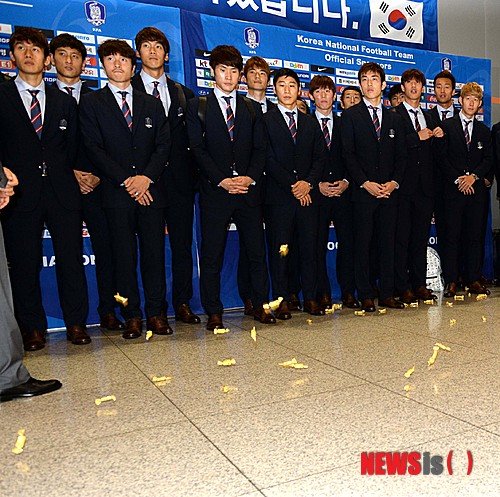
Upon their return, they were greeted with a toffee shower:

Note the toffees on the floor.
(source)

So yes, it's true: throwing toffee is an insult. But why? That question becomes fairly easy to understand when one sees what a traditional Korean toffee looks like. It looks like this:

Sweet and delicious.
(source)
This is called 엿 [yeot] in Korean. "Toffee" is a solid translation, because that's what yeot is--it is a candy created by solidifying thin strands of syrup. The insult is to say 엿 먹어라, or "eat yeot." Hm, put this long, sticky thing into your mouth? Wonder what that could possibly mean?

(For those lacking in imagination, it means: "Eat a dick.")

Interestingly, this insult is more often delivered with words rather than with the actual candy. In the right context, gifting the candy is not an insult at all. For example, someone who is preparing for an exam often receives yeot as a gift, as an encouragement to "stick" the exam (=pass the exam.) But of course, there is no mistaking the intent behind the toffee shower that the the national team received.

Several of you also emailed to ask how the Korean felt about the way in which the players were received. His feeling is: they probably don't deserve it, but it is part of the job description. Certain players--Son Heung-min comes to mind--played their hearts out, and definitely did not deserve to be told to "fuck off." Ideally, one should be able to focus-fire the insult. If one threw the yeot only to those who deserved the most blame, striker Park Chu-young and goalie Jung Sung-ryong would be getting a cannonball of candies to their faces. 

(And Jung won't be able to catch a single one of them. Hey-oh!) 

But that's what sports stars are. They are not paid big money to put a ball through a goal or a hoop or into the end zone. They are paid to serve as the vessel into which we project our desire. In this instance, Korean people's desire was hardly unreasonable; it is not as if there was an expectation that the team would win the whole thing. The team was expected to play hard, and play competently. More than a few players on the team failed at this. And if all they receive in return is some candies thrown at their face, that is not a huge injustice.

-UPDATE: July 3, 2014-

1.  Renowned food blogger Joe McPherson, who blogs at Zenkimchi, lodged this objection:  "Yeot is more like a taffy than toffee." Truth be told, TK did not even realize there was a difference between taffy and toffee. Alrighty then.

2.  This post was featured on Deadspin, in which some of Deadspin's commenters questioned why the yeot showing in the photos taken at the airport does not look like the yeot photo in this post. The reason is actually pretty simple: in the era of commercialization, the traditional long yeot has been re-packaged into a bite-sized candy. The bite-size yeot is still quite enough to convey the insulting message, and has the bonus of being a better aerial projectile.

3.  Now, for the really fun part. Since this post went up, a number of Korean readers provided several alternate theories as to why "eat yeot" is an insult. The theory that TK presented in the post is the prevailing theory: that yeot looks like penis, and "eat yeot" means "eat a dick." But the alternate theories are plenty interesting in their own right, so here they are:

- Probably the most colorful theory is that "eat yeot" comes from a botched exam in 1969. In the middle school entrance exam of 1969 (yes, Korea used to have an entrance exam for middle schools,) there was a question about the appropriate coagulating agent in the yeot-making process. Because of a mistake, there were two possible answers, but the testing authorities only recognized one of the answers. The enraged parents of the students then mobbed the testing authorities, shoving a homemade yeot made with the alternate substance into the faces of the befuddled testing authorities, screaming: "Eat this yeot! Eat it!"

This event actually did happen, but it is almost certainly not the origin of the phrase "eat yeot" because there are examples of "eat yeot" usage that pre-dates 1969. But it's a fun story.

- One alternate theory says:  "eat yeot" means "shut up," because apparently there is a Western tradition in which the dead's mouth was filled with thick syrup to keep it closed. This is most likely a wild speculation.

- Another alternate theory says:  "eat yeot" is a bastardization of "eat yeom" [염 먹어라]. "Yeom" is a process by which Koreans prepare the dead body for the funeral. That is to say--the theory is that "eat yeot" really means "go die." TK does not think this is particularly compelling, because yeom is a process rather than a substance that actually goes into one's mouth.

- There is even a dispute as to whether "yeot" refers to a man's genitalia. One of the leading theories is that "eat yeot" is a slang term originating from Namsadangpae [남사당패], a famed circus/clown act in Korea that has survived for centuries. According to the Namsadangpae lingo, yeot actually refers to vagina rather than penis.

Got a question or a comment for the Korean? Email away at askakorean@gmail.com.

Korea was never a Part of China

Dear Korean,

I’m from Singapore and visited Korea for the first time last week. I went to the National and National Folk Museums in Seoul, and noticed that the Koreans talked mostly of their early relations with China as one of “international exchange” or “cultural exchange”, seemingly having forgotten that Korea was a vassal state of the Chinese empire and paid tribute to it in order to maintain autonomy. Will the Koreans never admit to having been part of China? 

Keith


Short answer: Koreans will never admit such a thing, because Korea has never been a part of China.

The confusion most comes from misunderstanding the term "vassal state." The concept of "vassal state" (alternately known as a "tributary state") does not really exist any more, nor has it truly existed in the history of the Western civilization. But it does vaguely sound like "colony" of the early 20th century vintage, which leads to the confusion that Korea was a part of China. That is simply not the case. "Vassal state" is a diplomatic concept that was unique to pre-modern Northeast Asia. The concept must be understood within that context, because it makes no sense outside of it.

(It must be noted that nationalistic Chinese and Japanese deliberately sow this confusion. By doing so, nationalistic Chinese exaggerate the reach of the Chinese Empire; nationalistic Japanese justifies Imperial Japan's invasion of Korea, by claiming that Korea was simply going from one colonial master to another.)

Depiction of Korean tributary envoys to China, by Kim Hong-do, circa late 18th century
(source)

Put yourself in pre-modern Northeast Asia for a moment. There is one nation in the center--China, or 中國 (literally, the "center country")--that has been clearly superior to all nations surrounding it in every aspect of civilization, including military, trade, arts, philosophy and science, for two thousand years

Stop there, and let two thousand years sink into your brain. Think hard about how long that time is. Think about how old your grandparents are, and think about how many more generations you have to travel upward to hit two thousand years. Think about how much of our current tradition we take for granted, and how old those traditions are. Americans love to talk about their democratic tradition, but the age of that tradition is barely more than ten percent of the Chinese empire's history. Americans look to Europe for a deeper tradition, but European tradition prior to the Renaissance--which began in the 14th century--was nothing to write home about. 

This exercise is necessary because we the modern people often get myopic, and think that beliefs of the past are dumb or absurd. Not so: if Chinese hegemony has been true for two thousand years, it is simply true to anyone living within those two thousand years in China or near China. It is like living next to the Roman Empire that never went away until the 20th century. In such a situation, it would actually be irrational to think anything other than that the world revolves around China.

In those two thousand years, Northeast Asia was a "sinosphere"--a vast region in which China acted as a center of gravity of every aspect of human civilization. Of course, other nations in the region, including Japan, Vietnam and Korea, developed their own civilization which was quite glorious in its own right. But every nation in the sinosphere shared roughly the same governing philosophy, religion, social structure and writing system, all of which ultimately originated from China.

In this sinosphere, the emperor of China naturally considered himself to be the ruler of the entire civilized world. To the Chinese empire, the entire world consisted of: (1) China, (2) civilized nations that are vassal states to China (i.e. having a diplomatic relation with China,) (3) civilized nations that are not yet vassal states to China ( i.e. having no diplomatic relation with China,) and (4) uncivilized barbarians. During the Qing Dynasty in the early 19th century, China even considered the Netherlands, Portugal, Italy and England to be China's vassal states.

Informed by Confucianism (the shared ideology in sinosphere,) there was a mutual obligation between China and its vassal states. China provided vassal states with governing legitimacy, military security and (relatively) free trade. Vassal states, in return, provided a pledge of loyalty, acceptance of the Chinese emperor as the ultimate governing authority and regular tributes.

(More after the jump.)

Got a question or a comment for the Korean? Email away at askakorean@gmail.com.


Now, for the important part. Vassal states pledge loyalty to the Chinese emperor and give regular tributes. That's it. Vassal state had no other formal obligation to China. Vassal states had its own king, and had its own manner of choosing its king. Vassal states had its own government, which independently governed its own country. Vassal state collected its own taxes and had its own military. Throughout its relation with China before the modern times, all of the foregoing was true for Korea as well. China never chose any king on Korea's behalf. China had no formal role in forming Korea's domestic policies. China had no authority over ordinary Koreans, and China's authority over Korea's royal family was symbolic rather than real.

One may ask: what about the tributes? Is that not a tax that Korea paid to China?

No. The word "tribute" evokes an image similar to "tax," but it does not mean what you think it means. Recall that the relationship between China and its vassal states (including Korea) was based on Confucianism, which provides for a hierarchy with mutual obligations. Casual observers often say Confucianism is hierarchical, while losing sight of the fact that under Confucianism, there are obligations that run both downward and upward within the hierarchy. Even as the subordinate recognizes the authority of the superior, the superior must play its part to earn the authority.

In the context of sinosphere, this meant that the Chinese empire repaid every tribute. In fact, this is how the tributary system worked in sinosphere: the vassal state sends the tributary gifts as a sign of respect for China's authority. Upon receiving the gifts, the Chinese emperor would send back his own gifts to the vassal state's ruler as a sign of appreciation. This is hardly a tax on Korea; it was a trade between Korea and China under a different name.

There are ample historical evidence to show that both Korea and China recognized, as a practical matter, that Korea's tribute was a trade rather than a tax. For example, in the early days of Joseon Dynasty, China's Ming Dynasty required that Joseon pay tribute once in three years. But Joseon Dynasty vigorously insisted that it would pay tribute three times a year, and did end up paying tribute three times a year, and eventually four times a year. This makes no sense if the tribute were a tax; nobody volunteers to pay more taxes. Joseon Dynasty wanted to pay more tribute because it turned a profit on the return gift. [1]

Often, Joseon paid tribute by plying horses to the Ming Dynasty, which constantly needed horses to fend off barbarian attacks. The royal records from the Joseon Dynasty show that Korea did not send its own horses. Rather, Joseon purchased the horses from the Jurchens and re-sold the horses to the Ming Dynasty for ten times the price. [2] Being China's vassal state was particularly lucrative to Korea because outside of the tribute-repayment trade, China did not allow any international trade since the Ming Dynasty. [3]

The modern parallel to this relationship is not the colonial holds that appeared in the late 19th and early 20th century. The modern institution that is the closest to the sinosphere's tributary system is the British Commonwealth. Did you know that Canada and Australia had a queen? A number of states within the British Commonwealth--including Canada and Australia--still consider the British queen to be their head of state. Governor-General of Canada, who is appointed by the British Queen, summons the Canadian Parliament; Governor-General of Australia, who is also appointed by the British Queen, has the authority to dismiss the Australian government. (And in 1975, this authority was actually exercised.) Based on the foregoing, one could perhaps make an argument that Canada and Australia were a part of the United Kingdom. But given that Canada and Australia have their own governments just like Korea throughout its history before the 20th century, few would take that person seriously.

-Notes-

[1] From 이덕일, <조선 최대 갑부, 역관>
[2] Same.
[3] It must be noted that some Korean historians are skeptical of the claim that the tributary system always resulted in Korea's financial profit. See, for example, 계승범, <조선시대 해외파병과 한중관계>. But even those scholars generally agree that Korea clearly benefited in the non-economic sense, in the form of China's military protection, importation of books, art pieces and luxury goods, emergency lines of credit during famine, etc.

Got a question or a comment for the Korean? Email away at askakorean@gmail.com.

World Cup Thoughts

Yes, the Korean realizes that he is far overdue for a post. In his defense, how can one write a lengthy post when there are so many excellent games to watch?!

I mean, just look at this amazing Van Persie goal. I could watch this all day.


Actually, forget that. I could watch THIS all day.


Every flying man deserves a cape.

Which brings us to Team Korea, which takes the pitch tomorrow against Russia. Unlike the Korean's other homeland--the United States, conquerer of the Black Stars--Team Korea belongs to the soft, soft "Group of Life." Other than Belgium (the "sudden juggernaut,") all three teams in the group--Korea, Russia and Algeria--seem to have a legitimate chance of advancing. On paper.

But don't be fooled by the paper. Haven't you learned anything from the papers like the New York Post? Or the papers that constituted credit default swaps which suddenly became a value-destroying black hole? Papers lie, and they lie about Team Korea's chances. This Korean team is one of the worst Team Koreas in recent memory. Everything about them is terrible. The defense is a never-ending horror show, the offense too young and too green. The team treats scoring chances like a nerdy teenager running into a supermodel. Instead of confidently approaching the object of desire, they blubber, kick about wildly and then explosively self-destruct.

You think the Korean is joking, but he emphatically is not. Just look at this chart of least favorite teams compiled by the New York Times. Obviously, Korea's least favorite team is Japan because obligatory. But Korea's second least favorite team? Team Korea. Our nationalism is not so great that we root for crap. When we see crap, we hate it, even if it ends up being self-hate.

So, that's Team Korea's World Cup chances in a nutshell. It would be lucky to salvage two losses and a draw, while giving up no more than two goals in either losses. (There is a real chance that Korea could lose 5-0 to Belgium. Mark my words.) Team Korea is that sick puppy that you picked up from the side of the road, that mangy one which would surely die in a couple of days. Like your parents said, don't get too attached. Just sit back, quietly mutter "Well, at least we made the Cup," and thank your lucky stars if you have another country that you may legitimately root for. In that spirit:  USA! USA! USA!

(Seriously though, I really want Korea to win. Just one game. Is that too much to ask?)

Got a question or a comment for the Korean? Email away at askakorean@gmail.com.

The Sewol Tragedy: Part III - The Fallout


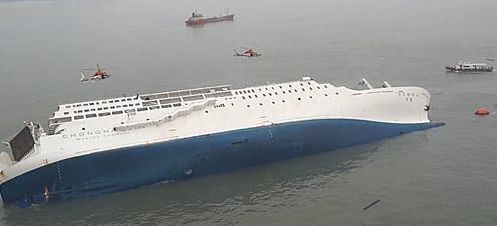
The capsized Sewol
(source)

One cannot get away from events in this age; the 24-hour news coverage and the Internet would not allow it. The Sewol disaster unfolded in real time in front of a horrified nation. When more than 300 lives--vast majority of them children--senselessly perish in an entirely preventable accident, it cannot help but affect the public. Similar reaction occurred in the United States, following the mass shooting in Newtown, Connecticut, in which dozens of young children died at the hands of a deranged shooter. 

But as horrific as it was, the Newtown shooting was over within an hour. Not so with the Sewol sinking. The ship sank for more an hour. The rescue effort subsequently unfolded for days, on live television. In the aftermath of the disaster, every last bit of incompetence from every corner of Korean society was magnified, amplified. It drove Koreans toward self-loathing, cynicism, and finally anger toward the political system.

What do You do When Everything Falls Apart?

The saying goes:  failure is an orphan, but success has a million parents. But in the Sewol disaster, the devastating failure had a million parents:  the captain who abandoned the ship, the ferry company that dangerously overstocked the ship, government that let deregulation run wild. Unfortunately, the failures did not stop when the ship sank. The hits continued to come from all directions: from the media, the government and the society as a whole.

*               *               *

First, the media. Purely from the perspective of mental impact, perhaps the most devastating error was the media's early reports that everyone aboard the Sewol was rescued. The cause of this error is under investigation, but it appears fairly clear that the media reported an unconfirmed rumor in the race to break the news first. This misfire significantly impacted the manner in which Korean public processed the news. When Koreans first learned the news about the Sewol sinking on the morning of April 16--around 11 a.m., 30 minutes after the ship completely capsized--they took it as a mildly scary event with no true harm done. The complacency set by the encouraging news made the full scale of the true horror much more destructive. Instead of no casualty, there were more than 300 missing, most of them high school students.

Got a question or a comment for the Korean? Email away at askakorean@gmail.com.


In the hours following the sinking, the media landscape in Korea was the lowest circle of hell in disaster porno. Because the Internet age came to Korea earlier than virtually any other country in the world, the issues that the Internet age created have affected Korea for longer, and more severely. The worst instincts for clickbaiting and sensationalism afflicted every part of the media, from tabloids to the more respected papers.

Newsis, an up-and-coming online newspaper infiltrated Danwon High School, and took a staged photo of a dead student by setting up an open notebook on the desk. Chosun Ilbo--the conservative newspaper that prides in its ability to steer Korean public opinion on any given issue--released an article discussing which insurance companies insured the Sewol, and what the expected payout was supposed to be while the ship was still sinking. Respected TV stations like SBS and jTBC harassed the freshly-rescued survivors for an interview. A reporter from SBS attempted to interview a six year old child, the rest of whose family perished in the ship. On a live television, a reporter from jTBC asked a rescued Danwon High School student if he knew his friends died, which caused the student to crumble in tears.

Second, the government. Much like the media, the government tortured the families of those aboard the Sewol as well as Korean public with a false promise: the possibility that there may be survivors in the capsized ship thanks to the supposed "air pockets." With a benefit of the hindsight, this promise was most likely illusory. Yet, if those in Korean government who were responsible for the rescue genuinely believed the possibility of air pockets, they moved far too slowly to capitalize on the opportunity.

Korea's Coast Guard did not have enough resources to rescue people from a capsizing ship, but other disaster-response authorities did. The Sewol's passenger made the first emergency call to the Coast Guard at 8:52 a.m. But the Coast Guard did not inform the Ministry of Public Security and Administration--which had more sophisticated rescue ships and helicopters to deploy--until 9:30 a.m. In fact, the Ministry first learned the accident from the television news rather than its subordinate. It was not until 9:31 a.m. until the Blue House was notified. By then, the ship was three minutes away from the point at which no escape was possible.

Further, the initial report to the government said nothing to indicate that a massive disaster was unfolding; it simply said that the Sewol was sinking, and the rescue was in progress. Incredibly, even after 5 p.m.--half a day after the ship sank--it appears that President Park Geun-hye did not have a clear idea of what exactly happened. During her visit to the rescue central, the President asked why the students could not be saved if they were wearing life jackets--implying that, in her understanding, the Sewol's passengers were floating in the sea rather than trapped inside the ship.

President Park Geun-hye at the disaster central.
(source)
The President was hardly alone in not having a clear sense of exactly what happened. Until 4:30 p.m.--again, half a day after the ship sank--the rescue central could not even figure out exactly how many people were on board on the Sewol, and how many were rescued. At 2 p.m., the rescue central announced that 368 were rescued, only to halve the number at 4:30 p.m. to 164 rescued. (The final tally of rescued passengers is 174.) When the Blue House was criticized for not having adequate information about the disaster, a senior Blue House official gave a tone-deaf response that the Blue House was not the "control tower" for disasters. While technically correct, this type of response could not help but give off the impression that the government was abdicating its duty to keep people safe.

Allegations of graft and corruption also emerged even as the rescue was progressing. There were allegations that the Coast Guard prevented the Navy divers from entering the water, such that the Coast Guard's private contractor (called Undine Marine Industry) could send its divers first. This led to suspicion that the Coast Guard delayed the rescue effort for the sake of taking care of its contractor. Because the government initially represented that there might be survivors in the overturned ship, it could not avoid the severe criticism that they were wasting precious time to play favorites.

Third, the society. Nearly as soon as the news broke, the Internet trolls in Korea's cyberspace were out in full force. Within minutes after the Sewol sinking was reported on the Internet, the vilest comments imaginable began appearing on the news story. (Here is a selection of them. I will not translate.) When the picture of Park Ji-yeong (the heroic 22-year-old crew member who drowned after saving dozens of children) appeared on the news, scores of god-awful lewd comments appeared below. It came to a point where Naver, Korea's largest search engine, put up a notice urging its users to not add comments injuring the victims' dignity. The media packaged those trolling comments into another round of clickbait news stories, fueling further outrage.

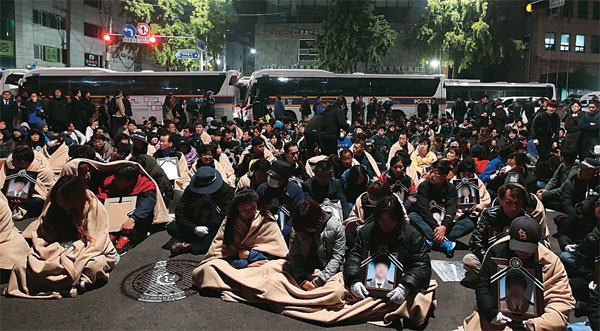
The situation was only slightly better offline. (Actually, it is not clear if it is better or worse that people were willing to say the same crap publicly.) Jo Gwang-jak, a pastor and the vice president of the conservative Christian Council of Korea said: "The low-income kids should have gone to a cheaper destination for their school trip. Why were they on a boat to Jeju and have this happen?" (Jo later resigned after much criticism.) Kim Si-gon, the head of new reporting at KBS, suggested that the sinking of the Sewol was not a big deal because more people die from traffic accidents. The enraged families of the Sewol victims protested in front of the KBS overnight, demanding apology. (Kim later resigned.)

Families of the Sewol victims protesting in front of KBS.
Each one is holding a picture of the deceased, which is used in a Korean style funeral.
(source)
Insensitivity was only one part of the way in which Korean society turned into a monster in the face of the disaster. Soon after the news broke, Facebook and other social networking sites were flooded with photo captures of text messages and instant messages, supposedly sent by Danwon High School who were still trapped inside the ship alive. Families of the students desperately latched onto them. But they were all fake. When arrested, the fabricators of the messages said they were hoping to drive up the subscribers to their social networking site accounts so that they may later sell them.

There is an even more brazen case of celebrity-seeking. One woman, who claimed to be a rescue diver, gave a live interview with a TV station to claim that another diver heard survivors from inside the ship, but the government is letting them die by not allowing regular divers join the rescue effort. This was a lie, as she was not at all a rescue diver. (In fact, it was revealed later that the woman has a long history of lying to gain celebrity. In another instance, she claimed that she was a cousin of T-ara's Hwayoung to take pictures with idol groups.)

*             *             *

Major disaster like the Sewol sinking has not struck Korea in a decade, or two decades depending on how one qualifies a "major disaster" that is comparable to the Sewol sinking. In 2003, 192 people died in a subway fire in Daegu, but the fire was a result of an arson. To find a death-by-thousand-cuts disaster like the Sewol sinking, one may have to go back to 1995 when a department store in Seoul that illegally modified its structure collapsed, killing more than 500. By 2014, Koreans were gaining confidence that the bad old days were behind them.

The Sewol tragedy shattered that confidence. Every major institution of Korean society--the government, the media, the church, the civil society--failed to properly function in some form or another. This total failure stunned Koreans. Without any institution in which to place their trust, Korean public first recoiled in self-loathing: what were we doing, letting hundreds of young children die on an illegally modified ship? Then followed cynicism and despair: perhaps nothing can be done, because something ingrained deep inside Korea's culture that inevitably drew them toward disaster. The depression was widespread and palpable: consumer spending in Korea in the later part of April dropped like a rock, similar to the way in which Americans responded to the 9/11 terrorism.

Next came the indignation against those responsible of preventing this disaster. Why couldn't the Coast Guard save a single person from inside the ship? Why couldn't the Ministry of Public Security put together the disaster response team more quickly? And why couldn't the president figure out what was going on for more than half a day?

President Park's Katrina Moment

President Park Geun-hye had only been elected a year ago, in a solid victory after the hotly contested presidential election. Throughout the presidential campaign, the fact that she was the daughter of the late president and dictator Park Chung-hee hampered her numbers. One of the turning points of the presidential campaign was when Park courageously recognized that the reign of her father--who ruled the country for 16 years after taking power by rolling into Seoul with tanks--violated the spirit of Korea's constitution and delayed the advent of democracy in Korea. This historic apologia by Park Geun-hye played a key role in her election, as it allayed the voter's fears that Korea was not about to travel backward toward her father's dictatorship.

In its first year, however, the Park administration began assuming a dictatorial posture that was not unlike her father's. As soon as she was elected, it was uncovered that Korea's spy agency and the military were engaged in a massive operation to sway the election by adding Internet comments and sending out tweets over Twitter, amplifying the Park campaign's message. When the Supreme Prosecutor's Office began prosecuting the head of the spy agency, the Ministry of Justice ordered an audit over the SPO--which caused the Prosecutor General to resign rather than suffer the indignity.

Contrary to her campaign promise, Park began taking first steps to privitize Korea's railways. When the railway union went into a strike in protest, Park sent thousands of policemen to arrest the union leaders based on an arrest warrant that the court later quashed. When the police got the wind that the union leaders fled their offices and escaped to the building next door--which belonged to a liberal newspaper--the police took a battering ram the newspaper's offices and ransacked the premises.

The Sewol tragedy struck as the public confidence in the Park administration was on the decline. The tragedy, standing alone, was enough of a damage to the administration; one of Park's major campaign promises was to enhance public safety. Park even changed the name of the Ministry of Public Administration and Security to Ministry of Security and Public Administration, to emphasize the government's responsibility for public safety. But any support that Park garnered by leveraging the public safety angle went underwater with the Sewol.

Still, the Park administration could have handled the crisis better. But it did not. Instead, it turned toward its dictatorial instinct, treating the angered people as its enemy rather than the people whom the president was elected to represent.

The first sign of trouble occurred five days into the search process. The family of the Sewol victims, gathered in a gym in Jindo that served as a makeshift shelter for the families, became restless in anger. Someone suggested visiting the President at Blue House; immediately, a crowd of 300 formed. But they were stopped as soon as they stepped outside of the gym; a hundred policemen were waiting for them. As it turned out, the government had planted plainclothes police inside the gym to conduct surveillance on the families. The families tried to rent a bus to go up to Seoul, but the government already told all the bus companies in the area to stonewall the families. Desperate, the families began walking toward Seoul in the middle of the night, trying to cover 200 miles on foot. Nearly a thousand policemen forcibly stopped them at the bridge connecting the Jindo Island and the mainland. Even after this episode, the families of the Sewol victims came under constant surveillance by plainclothes policemen for signs of trouble.

The government also cracked down on criticism of the rescue effort, while tightening its control over the media. Daegu Metropolitan Office of Education censured an area public school teacher who criticized the president on Facebook. Program directors at television station who complained that the news was not sufficiently critical of the President were suspended. (Recall that, in Korea, the government indirectly controls two of the three network TV stations.) In fact, the government directly ordered KBS to avoid criticizing the Coast Guard and the rescue effort.

Needless to say, this is a terrible response by the Park administration. Beyond the obvious creepiness and infringement of the fundamental freedom of movement, press and speech, the Park administration's actions neatly overlapped with the malfeasance of the Sewol's captain that served as a proximate cause of the disaster: stay where you are, don't cause trouble, so that we may escape out of this jam first. Inspired by this overlap, dozens of demonstrations emerged across Korea to protest the government reaction. For the most part, the protesters marched silently, only holding up a sign that said: "Stay Put."

Silent protesters march in the Sewol's aftermath.
(source)
To her credit, President Park responded strongly. She sacked the Prime Minister (who is akin to Vice President in the U.S.,) and abolished the Coast Guard, which is to be replaced with a newer and hopefully more competent agency. Korea's Supreme Prosecutor's Office charged the Sewol's captain with murder, and is currently trying to arrest Yoo Byeong-eon, the ultimate owner of the ferry company that operated the Sewol. But Park's numbers--which was as high as 61 percent prior to the accident--continued to sink. Her choice of new Prime Minister, Ahn Dae-hee, did not even last a week before withdrawing his nomination based on the allegations that he unethically wielded his influence as a former Supreme Court Justice to steer inordinate number of cases to his law practice.

All of this amounts to a real political consequence for the president and her conservative party. In less than a week, Korea is facing local elections where Koreans elect mayors, provincial governors, etc. What should have been a conservative landslide across the board is now up in the air, with the crown jewel of Seoul mayoralty now solidly in the hands of the current, progressive mayor Park Won-soon. Even beyond the local elections, it is likely that this disaster will be the lasting image of Park Geun-hye's presidency. It is her Katrina moment.

Got a question or a comment for the Korean? Email away at askakorean@gmail.com.

Culturalism and Understanding of Culture

[Series Index]

Propagandist poster symbolizing the Lusitania.
(source)
A sinking ship has been a subject of romanticized tragedy for at least a century, going back to the Lusitania and the Titanic. In a large part, this treatment of maritime disasters happens because a sinking ship is such a perfect vehicle for a narrative. A ship is a self-contained civilization, constantly exposed to the apocalyptic possibility for any number of reasons. Those reasons, eventually, become the story of each sinking. The Lusitania is remembered as a story about German aggression; the Titanic, a story about human hubris. If the story's devices include the death of hundreds of young school children, it can only be more compelling.

So, inevitably, the tragic sinking of the Sewol became another story. Initially, much of the story revolved around the captain's criminal dereliction of duty, as he was seen--as the world was watching--abandoning the ship without any concern for the passengers. But in a matter of days, the story turned into the one about Korean culture--how its Confucianism made its children too unthinking and obedient to save themselves when the ship's PA system instructed them to stay in their cabins as the ship was sinking. 

In the wake of the Asiana plane crash last year, I discussed the concept of culturalism, which I defined as "unwarranted impulse to explain people's behavior with a 'cultural difference,' whether real or imagined." I tried to show that the fountainhead of cultural explanation for airplane crashes, i.e. one chapter in Malcolm Gladwell's Outlier, was based on shoddy reasoning founded upon cherry-picked evidence. Then I explained the danger of culturalism: it obfuscates the truth, distracts from the real issue, and wipes away the individuality of the people who are "explained" through culture.

This time, before I could comment, several writers produced excellent pieces of writing that persuasively argued against the reductionist claims about Korean culture and the Sewol disaster. The best ones came from John Bocskay and Jakob Dorof--you should read them. Because Bocskay and Dorof did such an excellent job refuting the reductionist, "Korean culture sinks ships" claim, I feel that I should not belabor the point.

Instead, I will address a different angle. As to my Asiana article and the Sewol-related articles by Bocskay and Dorof, the objections were the same: culture is real, and it exerts real force on human decisions. When I presented my critique of culturalism in the context of the Asiana flight crash, most of the objections, in so many words, said there really was a cultural difference in communication patterns, which may well affect airline safety. Likewise, to articles by Bocskay and Dorof, many objected by claiming that culture clearly impacted the way in which the Sewol disaster unfolded, and it is not only incorrect, but also willfully blind, to say otherwise.

But such objections miss the point completely, since neither I nor Bocskay and Dorof argued that there was no such thing as culture or cultural differences. Recall that the definition of culturalism is "unwarranted impulse to explain people's behavior with a 'cultural difference.'" In my original piece about culturalism as well as in my subsequent discussion, I stressed repeatedly that cultural explanations have their place. I have little doubt that Bocskay and Dorof would agree with me in saying that culture is real, and it impacts human actions.

This leads to a natural question:  if culture is real, then what separates a cultural explanation from a culturalist one? 

(More after the jump.)

Got a question or a comment for the Korean? Email away at askakorean@gmail.com.

*             *             *


When people offer an explanation based on "Korean culture," not simply in regards to the Sewol disaster but in general, I often find that the speaker is not entirely clear on what she means by "Korean culture." As far as I can tell, the definition of "Korean culture" in those explanation oscillates between two different poles of meanings.

In certain cases, "Korean culture" denotes a type of unchanging, indelible essence, common to Koreans and only Koreans. In this sense, "Korean culture" commands the actions of every Korean who has ever lived, past, present and future. It dictates the decisions of any Korean who has ever lived in any part of the world, be she a Korean in Busan whose family never left the city for a thousand years, or a Korean-Chinese whose family migrated outside of Korea more than a hundred years ago. It is obvious that this definition is no more than disguised racism, with "culture" serving as another dog whistle. Any "cultural" explanation based on this definition holds little explanatory power, as it collapses under its own weight.

In other cases, "Korean culture" is a shorthand for any commonly observable pattern of thoughts or behavior in Korea or among Koreans. As a shorthand, "Korean culture" amounts to little more than the sum of its highly diverse parts. "Korean culture," in this sense, is divisible to nearly infinite number of sub- and sub-sub-cultures upon a closer look. One can speak of Korea's corporate culture, culinary culture, pop culture, political culture, maritime culture, school culture, familial culture, Internet culture, youth culture, regional culture. Sometimes, these sub-cultures and sub-sub-cultures point to the same direction; at other times, they either subtly diverge, or actively clash with one another.

I believe that the second definition is the correct way of understanding culture. When I say "culture is real and exerts real influence," I am employing this definition. I do so because the difference between the first definition of "Korean culture" and the second definition of "Korean culture" is plain. The first definition is a yoke on Koreans, reducing them to unthinking automatons; the second definition is merely a descriptor, a shorthand that we are forced to use even though the shorthand never does justice to the real thing. The bodies of water that cover 71 percent of the Earth's surface include both extreme depth and extreme height, extreme heat and extreme cold, extremely large creatures and the extremely small ones. Yet we are forced to call them all "the ocean," for the sake of manageable brevity. Likewise, we may refer to "Korean culture" without losing sight of the fact that the vastness and complexity of hundreds of millions of actions taken by hundreds of millions of people every second can never be truly reducible to those two words.

One way of understanding culturalism is:  it is the moment at which the second, expansive definition of culture is tainted by the first, reductionist definition of culture. In most cases, the term "culture," as used by those who explain events by way of culture, represents a varying level of mixture of the two definitions. Importantly, those who offer the cultural explanations rarely understand the precise definition of the term "culture" that they employ, i.e. their exact location relative to the two poles. Like much of the racism in the world, culturalism is expressed not through active malice, but through unthinking deference to subconscious bias.

But regardless of whether the speaker is aware of his own bias, we know that much of the cultural explanations floating in the world are infected by culturalism, a form of bias. We can see this in the manner in which cultural explanations are offered. Fans of cultural explanations exhort that it is eminently fair to consider whether culture contributed to certain events. But the manner in which cultural explanations are employed gives a lie to this claim, since the applications of cultural explanations are anything but fair.

We know, for example, that the facts that do not fit the pre-existing stereotypes about Korea are rarely explained by way of Korean culture. This is a significant data point, for the term "stereotype" may well be another way of describing the reductionist understanding of culture. Several of the Sewol's junior crew members died as heroes, saving as many school children as they could before they perished. But there is little discussion about how Korean culture impelled those crew members to selflessly give their lives. If it is so eminently fair to cite culture as a significant contributor of human actions, why is such heroism not hailed a cultural achievement by Koreans?

Any part of Korean culture that that does not fit the stereotype about Korean culture is also disregarded. The culturalist explanation about the Sewol tragedy revolved around the supposed "Korean culture of obedience." But Korea marched from fascist dictatorship to democracy through relentless resistance and protests against the authority. A significant part of that protesting tradition of Korea involved young students, right around the age of the Danwon High School students who perished on the Sewol. If it is so eminently fair to introduce culture to explain behavior, why is one part of the national culture prioritized over another?

We also know that a cultural explanation overwhelmingly is more likely to emerge regarding a disaster in Asia or involving Asians (Fukushima, the Asiana crash or the Sewol sinking) compared to a disaster in North America or Europe (Katrina, Deep Water Horizon, Santiago de Compostela derailment.) This, too, indicates bias: cultural explanation is overwhelmingly more likely to appear when something happens in a faraway land to inscrutable people. The same question may be asked:  If it is so eminently fair to cite culture as a significant contributor of disasters, where are all the cultural explanations that expound on how American culture contributed to the bumbling response after the Hurricane Katrina, how British culture contributed the BP oil rig explosion, or how Spanish culture is to blame for the massive train derailment?

*             *             *

Here, a short detour. The last point requires further discussion, because of this common objection: the claim that Americans and Europeans engage in cultural examinations of themselves all the time, chief example of which is the gun culture of America. This is a rather weak claim; it is plain that there is significantly less willingness to explain events that happen in America and Europe in terms of culture. (Again: where are all the cultural explanations that explain how British culture contributed to the BP oil disaster?)

To the extent that this weak objection has a grain of truth, it only serves to illuminate the difference between the two definitions of culture that come into play in a cultural explanation. For it is clear that "culture" in the context of Americans' discussions of "America's gun culture" refers to the expansive definition of "culture." When Americans discuss their own country's gun culture, absolutely no American thinks that the word "America" in "America's gun culture" serves to bind all Americans, or even a majority of Americans. Indeed, it is not an exaggeration to say that when Americans speak of how Americans need to fix their gun culture, they are quietly whispering to themselves:  "except me."

The same is true for a similar objection:  the claim that Koreans constantly point to their own culture to explain the events in Korea--if Koreans themselves can use cultural explanation, why not us? But when Koreans are critiquing their own culture, the same silent whisper is constantly present:  "except me." When a non-Korean repeats Koreans' criticism of their own culture, the silent whisper of "except me" takes on a very different meaning. An "except me" uttered by a member of a culture speaking of her own culture serves to limit the applicability of "culture"; the same uttered by someone outside of that culture does the opposite.

*           *           *

To return to the earlier point: none of this is intended to say that there is no such thing as culture. Culture is real, and it exerts real influence on people. What, then, can one do to talk about culture while avoiding the pitfalls of culturalism?

Judging from the experience of running a moderately successful blog about Korean culture, what I have found effective is to directly address the components of culture. After all, "culture" is a shorthand, containing a vast array of multitudes. An effective exposition of culture would necessarily be an unpacking of that shorthand.

I deliberately chose to write this post within the series after the post about the causes and contributing factors of the Sewol tragedy. My first priority in writing the second part of the series was to provide a concise summary of the relevant facts and circumstances surrounding the tragedy. But I also had a secondary aim:  I was trying to show just how much of the tragedy I could explain without any explicit reference to the word "culture." So the post included discussions about lax regulation by a neoliberal government, unchecked greed by a struggling corporation that led to a distorted business model, potential corruption and all-around incompetence.

I am humbled that the post was very well received; I am yet to see any criticism that the lack of express reference to culture somehow leaves the post incomplete. (To the contrary, many of the positive reviews for my post praised it for being "complete.") However, my post is still a thoroughly cultural piece, as it discusses many different cultural trends that one can encounter in Korea. Years of neoliberal economic reforms led to an unstable labor market, which fostered a culture of hapless dependency among the incompetent crew of Sewol. Lack of adequate disaster training bred a culture of amateurism within Korea's disaster response system, although their effort must be praised. At many junctures, large and small safety regulations were ignored, implying at a weak culture for public safety.

But how much would my post improve, had I chosen to explain the tragedy in those terms? How would the explanation become better by filtering everything through the word "culture," which inevitably invites a reductionist interpretation? In my estimation, this is simply the better way of explaining a foreign culture: break it down to its components, by presenting the facts and circumstances that gave rise to that particular pattern of behavior. Aim for true empathy and understanding by suggesting that, if you encountered the same facts and circumstances, you would do the same. I do not always succeed in doing this, but it has always been the guiding principle for this blog. The modicum of readership that this blog has enjoyed seems to say that I am not alone in the opinion that this is the better approach.

Got a question or a comment for the Korean? Email away at askakorean@gmail.com.

The Sewol Tragedy: Part II - Causes and Contributing Factors

[Series Index]

[NOTE:  I finished writing the first draft of this post on April 30, 2014. Since then, additional facts have been uncovered. I will periodically update this post as I learn new, relevant facts.]

The Sewol. The ferry company's logo ("Chonghaejin") is also visible.
(source)

The sinking of the Sewol is a terrible disaster that was entirely preventable. Instead, a confluence of numerous circumstances, people and their decisions resulted in the senseless destruction of more than 300 lives, overwhelming majority of whom were young high school students, about to enter the prime of their lives.

What caused the sinking of Sewol? What contributed to those deaths? The best way to answer these questions is to sort out the actions of the important parties involved at important junctures.

In this accident, there are three significant actors:
  • The captain and the crew, who was immediately responsible for the ship and the passengers;
  • Cheonghaejin Marine Co., the ferry company in charge of maintaining and operating the ship, and; 
  • The government, which played a dual role of the regulator and the rescuer. 
There are four significant segments of time:
  1. Before the accident; 
  2. Between when the Sewol set sail and when it began to list; 
  3. Approximately 40 minutes between when the ship began to list, and 
  4. After the rescue efforts began. 
When we examine how these three actors behaved in the four segments of time, we begin to have an understanding of what could have prevented this tragedy.

THE ACTORS

The Crew

There were 33 crew members on the Sewol. Out of the 33, 15 were the senior crew members who were in charge of steering and operating the ship (as opposed to, say, manning the snack bar or providing customer service.) The 15 include: 69-year-old Captain Lee Jun-seok [이준석], two First Mates, one Second Mate, one Third Mate, three Helmsmen, three Engineers and four Assistant Engineers. The other 18 were junior crew members, which included stewards, an event planner and custodians. All 15 senior crew members were in the bridge when the ship began sinking; all 15 survived. Out of the 29, 20 crew members survived--a rate vastly superior to the survival rate of the entire ship (174 out of 476) or that of the Danwon High School students (75 out of 325). Currently, seven out of the 15 senior crew members are under arrest pending investigation.

Because the 15 senior crew members bore the responsibility for the steering and operation of the ship, this post will only focus on them. When I refer to "the Crew" from this point on, I am referring to the 15 senior crew members.

The Company

Cheonghaejin [청해진] Marine Co. (alternately romanized as "Chonghaejin") is the largest coastline ferry company in Korea. Cheonghaejin was established in 1999; its name is for the famous historical seaside fortress in the southwestern part of Korea. Cheonghaejin operates three lines with four ships, and operates the water taxi on the Han River in Seoul.

The distinction of being the largest coastline ferry company in Korea is less impressive than it sounds. In terms of efficiency, passenger ferry is no match for high speed rails and low cost airlines. Thus, Korea's coastline ferry companies tend to be small, and the profit margin thin. Cheonghaejin was a small-ish mid-size company that has been losing money for the last several years.

The Incheon-Jeju line, however, was a moneymaker for Cheonghaejin. Cheonghaejin has a monopoly on the Incheon-Jeju line, for which it operated two ships: the Omahana and the Sewol. Cheonghaejin made significant investment to create the monopoly. Even as Cheonghaejin was losing money, it had spent more than $14 million in purchasing and modifying the Sewol in 2012. With two ships, Cheonghaejin was able to set sail five times a week, absorbing all demand for the line and freezing out other ferry companies.

The line was particularly lucrative because Jeju, a large island, consistently required supplies from the mainland. Although both the Omahana and the Sewol were passenger ships, they were also able to carry trucks and container cargoes. Doing so came with an additional price advantage: because the two ships were technically passenger ferries, they were exempt from the fees that the Jeju seaport charged on cargo ships. Essentially, Cheonghaejin was making up the decreased demand in passenger ferry by doubling as a bootleg cargo carrier.

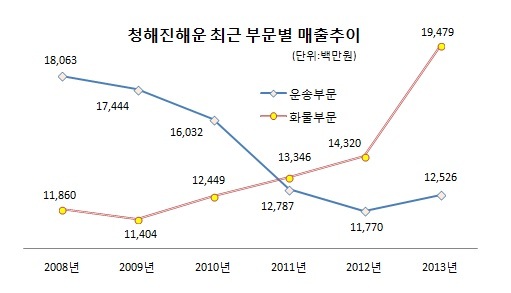
Cheonghaejin's revenue from 2008 to 2013.
Unit = KRW 1M (~US$1,000).
Blue line represents income from passengers; red line represents same from freight.
(source)

Cheonghaejin is ultimately owned by 73-year-old Yoo Byeong-eon. In addition to overseeing a small corporate empire, Yoo's day job included being a pastor for a Christianity-derivative cult called the Saviorists [구원파]. (I previously covered the Saviorist cult in this blog. For those living in New York: they are the creepy Asian people in orange t-shirts talking about "Bible Crusade.") Currently, Yoo and his cronies are under investigation for embezzlement and bribery.

The Government

President Park Geun-hye's administration is entering its second full year. The previous administration was led by President Lee Myeong-bak, who was also a conservative like his successor. In the area of economic policies, President Lee was the most neoliberal president that Korea has ever had. Like America's Republican presidents after which he modeled himself, President Lee pushed for lower taxes, privitization and deregulation. The Park administration was content to keep the trend going.

Outgoing President Lee Myeong-bak,
congratulating the newly elected Park Geun-hye after the 2012 election.
(source)

During her presidential campaign, one of Park's signature themes was public safety. After Park took office, one of her first notable moves was to change the name of the Ministry of Public Administration and Security to the Ministry of Security and Public Administration--so as to convey the message that public safety takes priority in the Ministry's mission.

After the jump, how these three actors before, during and after the sinking of the Sewol.

Got a question or a comment for the Korean? Email away at askakorean@gmail.com.


BEFORE THE ACCIDENT

The Government

Cheonghaejin's purchase of the Sewol was made possible by Lee Myeong-bak administration's deregulation drive. In 2008, under the Lee administration, the maximum allowable age for a passenger ship went from 20 years to 30 years. This allowed Cheonghaejin to purchase an 18-year-old Japanese ferry ship that was going out of commission, for nearly scrap-metal price.

The advanced age of the ship caused constant problems. Company records show that the Sewol had engine RPM issues two months prior to the accident. A report from the beginning of April shows that the Sewol's helm would lose power.

The Company

Once Cheonghaejin purchased the Sewol, it added two more floors on top of the ship in order to hold more passengers and cargo. The ship, originally three stories, was modified to five stories. To build on top, Cheonghaejin removed a drawbridge ramp, which weighed 50 metric tons, from one side of the ship. In short, the modifications made the Sewol a much more unstable ship:  its center of gravity became higher, and a massive piece of metal (the ramp) was removed from only one side of the ship. A former Engineer of the Sewol said the ship would frequently list, sometimes as much as by 10 degrees. One Cheonghaejin employee quit the company before he was concerned of the Sewol's instability.

Cheonghaejin, a small, financially struggling company, also cut corners on safety. Because it never had enough money to invest in a new ship, it had consistently set itself up for the safety hazards that come with older ships. (In 2001, for example, Cheonghaejin lost two ferry ships due to fire.) Even though the Sewol was more of a (thinly) disguised cargo ship rather than a passenger ferry, the ship never had a proper harnessing system for containers. Unlike a regular container ship, there was no locking mechanism on Sewol's deck that held the containers to the floor, nor were there winches that would mechanically tighten the steel cable over the top of the containers. The contains simply rested on the deck, nominally held down by ropes that were tied to the hooks in the ship. Further, Cheonghaejin outsourced the harnessing of the cargo to a subcontractor. The subcontractor, afraid of losing Cheonghaejin's account, never could ask the ferry company to invest money in proper harnessing mechanism.

In 2013, the company only spent around $500 on the crew's safety education. As discussed further below, the company also hired inexperienced crew as a way to save money.

The Crew

As a group, the crew members had terrible job security. Korea's labor law is closer to Europe than the United States, in that employees are legally guaranteed certain rights and benefits, such as the right to unionize, receive pension and take annual leaves. However, the deregulation trend in Korea for the last decade eroded those guarantees. Currently, the labor market in Korea is divided into two groups:  "regular workers" [정규직], who receive the traditional benefits provided by Korea's labor laws, and "irregular workers" [비정규직], who do not. Unlike with the regular workers, the employer may fire the irregular workers without cause and without paying severance. As a result, compared to regular workers, irregular workers have little to no leverage with the company.

As of late 2013, approximately 2/3 of all wage workers in Korea were regular workers, 1/3 irregular workers. With the crew of Sewol, the reverse was true:  nine out of the 15 crew members were irregular workers, including the Captain. Nine out of the 15 crew members had worked for the Cheonghaejin for less than six months. (The Captain had worked for the company for more than a decade, but was recently converted into an irregular worker, presumably because of his age.) One of the First Mates joined the company the day before he boarded the Sewol. Among the top three decision-makers of the ship--i.e. the Captain and the two First Mates--only one of the First Mates was a regular worker.

The crew members were also paid poorly. Employees for domestic ferries receive less than two-thirds of the same for the ships that travel internationally. In addition, irregular workers generally get paid less than regular workers. This means that the Sewol's crew tended to be either too old or too inexperienced. The Captain was 67 years old; the Third Mate, who was steering the ship when the ship began listing, was 25 years old. Both the Third Mate and the Helmsman who were at the helm when the ship began listing had never worked on a passenger ferry until they joined the crew of the Sewol, less than six months prior.

Particularly problematic was the Captain Lee Jun-seok. Lee, in addition to being an irregular worker, was a substitute who was called in when the original captain--who is a regular worker--was taking his labor law-mandated monthly leave. Further, contrary to the normal practice of having two alternating captains for each ship, Lee served as the substitute captain for both the Sewol and the Omahana, the two ferry boats from Incheon to Jeju.

THE SEWOL SETS SAIL

Map of South Korea.
Incheon is to the west of Seoul. Jeju is the large island in the south.
The Sewol was passing the southwestern tip of Korean Peninsula.
(source)

The Company

Korean Register of Shipping, a non-profit organization, certified the safety of the Sewol after modification with several conditions. Because the ship became significantly heavier, KRS ordered the Sewol to reduce the maximum cargo load from 2,437 tons to 987 tons. Further, the Sewol had to increase the amount of ballast water it carried in the stabilizing tanks from 1,023 tons to 2,030 tons.

However, Cheonghaejin habitually overloaded the Sewol with cargo, as the cargo business from Incheon to Jeju was the true moneymaker for the company. The Sewol's regular captain, as well as the substitute Captain Lee, routinely complained that the company was overloading the ship. On the day the Sewol embarked its fateful journey, the ship's First Mate told the company that unless it stopped loading, the ship would sink. The Sewol's bill of lading shows that the ship carried jaw-dropping 3,608 tons, 3.7 times the allowed cargo weight. In order to balance the ship, the company almost certain drained a huge amount of ballast water. The net effect was to make the ship extremely unstable due to excess weight, with not enough ballast water to balance the ship.

The Government

How did the Incheon Coast Guard, which was in charge of overseeing the port of Incheon, fail to catch this unconscionable overloading? Part of it was that the Sewol's paperwork indicated that it was allowed to carry the total weight (as opposed to the cargo weight) of 3,963 tons. The paperwork should have been approved by the Coast Guard, Incheon Port Authority, the KRS, Korea Ship Safety Technology Authority and Korea Shipping Association. All of the foregoing are under investigation, as the incorrect paperwork strongly suggests potential corruption.

In fact, the Sewol was not even supposed to leave Incheon. The night before the accident, the port of Incheon was surrounded in thick fog. The Sewol, which was supposed to leave at 6:30 p.m., left the port at 9 p.m. However, at 9 p.m., the visibility was too low for the Sewol to be allowed to leave. On the night of April 15, 2014, the Sewol was the only ship that was allowed to set sail out of Incheon.

The Company

Cheonghaejin's preferred course from Incheon to Jeju included a passage through the Maenggol Road [맹골수도], near the southwestern tip of Korean Peninsula. Maenggol Road is named after the nearby Maenggol-do island, which means "the island of fierce bones" in reference to the numerous sharp rocks around the island.

The waters of the peninsula's southwest is treacherous. The body of water there is alternately known as Dadohae [다도해], "the Sea of Many Islands." The largest among them is the Jindo island, home of the famously smart and loyal Jindo dogs. The numerous small islands form a huge number of channels, which funnel the water into a surprisingly fast and choppy ride. More than 400 years ago, the legendary Admiral Yi Sun-sin [이순신] used the unpredictable current around the southwestern sea to achieve one of the greatest naval victories in recorded history, which is now known as the Battle of Myeongryang [명량해전]. With only 13 warships at his disposal, Yi lured the oncoming Japanese fleet of 133 ships into the narrows between Jindo and the mainland, called Uldolmok [울돌목]. At the Uldolmok narrows, the Japanese fleet was caught in the current that suddenly reversed direction, exactly as Admiral Yi designed. The Japanese fleet, unable to maneuver against the current, became sitting ducks for Korean fleet's focused cannon fire. The Japanese fleet withdrew after losing more than 30 ships.

The Sewol's path was in that vicinity. The Maenggol Road, located on the opposite end of Jindo from the Uldolmok narrows, has the second-fastest current speed in Korea after the Uldolmok, at approximately 6 knots (7 miles per hour.) The tide in the Maenggol Road was so fast that Korean government was planning to build a tidal power plant nearby. Naturally, it is an accident-prone course: 28 maritime accidents occurred in Maenggol Road since 2007, which was enough for Korean Marine Safety Tribunal to advise ferries to avoid taking it.

On the plus side for the company, however, taking the Maenggol Road instead of going around it saved seven nautical miles of distance. So the Sewol would sail through the fast current.

The Crew

The Sewol was speeding, likely because the ship embarked 2.5 hours after it left Incheon and wanted to make up the time. As the ship was entering the Maenggol Road, the Sewol was traveling at 19 knots, or approximately 22 miles per hour. The off-duty helmsmen of the Sewol said, normally, the ship would travel through the Maenggol Road at between 16 to 18 knots. A speeding ship tends to turn faster than a slower ship.

At the time, the ship was being steered by the 25-year-old Third Mate Park Han-gyeol [박한결] and a 55-year-old Helmsman Jo Jun-ki [조준기]. They were not supposed to. The crew's shifts were set up such that when the Sewol passed through the Maenggol Road, it would be controlled by the First Mate, who would be relieved by the Third Mate once the ship reaches the open sea between Korean Peninsula and Jeju island. But the ship departed more than two hours after the scheduled time, which meant that the First Mate's shift was over before the ship reached the Maenggol Road.

So the Third Mate was in charge. Put together, the Third Mate and the Helmsman had worked for Cheonghaejin for only nine months. Before working on the Sewol, neither the Third Mate nor the Helmsman worked on a passenger ferry. Before this time, the Third Mate had been in control of the ship through the Maenggol Road exactly once, going from Jeju to Incheon.

Korea's Sailor Act provides that the captain must steer the ship himself when the ship is passing through dangerous areas, such as a narrows. But the Captain of Sewol was in his cabin. The Captain stopped by the bridge 10 minutes before the accident to give several instructions, and returned to his cabin. It is unclear what he was doing in the cabin. Depending on where you look, the accusations run from ludicrous to salacious.

The Sewol's course in the Maenggol Road.
The island on the northeastern corner of the small map is the Jindo island.
(source)

It is unclear why the Sewol made that fateful turn. The Third Mate and the Helmsmen gave conflicting statements to the police. The Third Mate and the Helmsman may have made a mistake, or the ship's rudder may have malfunctioned. We do know, however, that the Sewol turned sharply. The ship, modified to have a higher center of gravity and weight imbalance on each side, carrying more than three times the recommended weight in cargo which was not properly secured, with much of the stabilizing water drained out of its ballast tanks, started to list beyond the crew's control.

The Sewol turned sharply, lost its balance, and began sinking at 8:48 a.m., on the morning of April 16, 2014. The nearest Coast Guard station, in Mokpo, was nearly 30 miles away.

THE SEWOL SINKS FOR 40 MINUTES

The Crew, the Company and the Government

As discussed further below, all relevant parties--the crew, Cheonghaejin, the Coast Guard, the Vessel Traffic Service--were aware that the ship was sinking by 9:07 a.m., less than 20 minutes after the accident. For the Sewol's passengers to escape from the ship, they had to be outside by around 9:50 a.m. Had any one of the actors made the correct judgment to evacuate ship during those 40 minutes or so, virtually all passenger could have been saved. Instead, all parties engaged in varying degrees of incompetence, indecision and confusion, which cost more than three hundred lives.

The Crew

At 8:55 a.m., seven minutes after the crew lost control of the ship, the crew sent a distress call to the Vessel Traffic Service (VTS) at Jeju. The Crew's distress call was three minutes later than the 119 call from a Danwon High School student. To its credit, the Coast Guard station in Mokpo almost immediately dispatched a rescue team in response to the 119 call.

It is unclear why the crew sent the distress call to the VTS station at Jeju (which was still more than more than 50 miles away) as opposed to the nearest VTS station at Jindo. One former crew member of the Sewol suggested that the Crew probably called Jeju VTS instead of Jindo VTS to avoid attracting too much attention by the authorities.

The Government

The Crew's decision to call the Jeju VTS instead of the Jindo VTS caused critical inefficiency, although the inefficiency was not merely the Crew's fault. By regulation, Jindo VTS was required to monitor the movement of all vessels passing through its jurisdiction. But Jindo VTS did not establish communication until 9:07 a.m., nearly 20 minutes after the Crew lost control of the ship. It took 12 minutes for the Jeju VTS and the Mokpo Coast Guard to relay the distress call to the Jindo VTS station.

Even if the Jindo VTS station received the news earlier, it is unclear if much more could have been done in terms of rescue. The nearest Coast Guard station was in Mokpo, more than 30 miles away from the Maenggol Road and the Sewol. In short, despite the accident-prone nature of the Maenggol Road, the Coast Guard was poorly positioned to help.

The Coast Guard also did not have enough personnel to deal with a major disaster like this one. Although Mokpo Coast Guard did send the rescue team at its disposal at quickly as it could after receiving the 119 call, the team was made up of only two helicopters and two boats. The next wave of rescue team, from Korean Navy, did not arrive until 10:21 a.m., well after the 9:50 a.m. "deadline." A boat with rescue divers did not arrive until 11:24 a.m., because the divers did not assemble until 9:30 a.m. By then, Mokpo Coast Guard did not have the ship or the helicopter to send the divers directly from Mokpo to the Sewol. Some of the divers hitched a ride with the police helicopters, which were located farther inland. Some of the divers had to drive from Mokpo to Jindo, then take the boat from Jindo.

The Company

At 9:01 a.m., one of the junior crew members of the Sewol--a cabin manager for the passengers--called the Cheonghaejin Marine Co., presumably to report the accident. Afterward, the company telephoned the Captain once, and the First Mate five times. The last phone call between the Crew and the company was at 9:37 a.m. By then, the rescue team had arrived.

The contents of those telephone calls are under heavy scrutiny by the police; as of now, they are not yet known. However, the fact that Cheonghaejin called the First Mate (who was, recall, a regular worker) far more frequently than the Captain (an irregular worker) suggests that the actual decision-making authority did not correspond with the formal order. It appears that the Captain was the leader in name only; the First Mate was calling the shots. The First Mate was the one that communicated with the Jindo VTS, and he was the first to escape the Sewol when the rescue team arrived. According to the video of the rescue, the Captain did not exit the ship until the First Mate waved him out of the bridge.

The Crew

In the 40 minutes between 8:55 a.m. (the distress call) and 9:37 a.m. (last call between the First Mate and the company,) the Crew does nothing to save the passengers. Nothing. Fucking nothing. The Crew did not even answer the call from the junior crew members from below the deck, who could only tell the passengers haplessly to remain in their cabins.

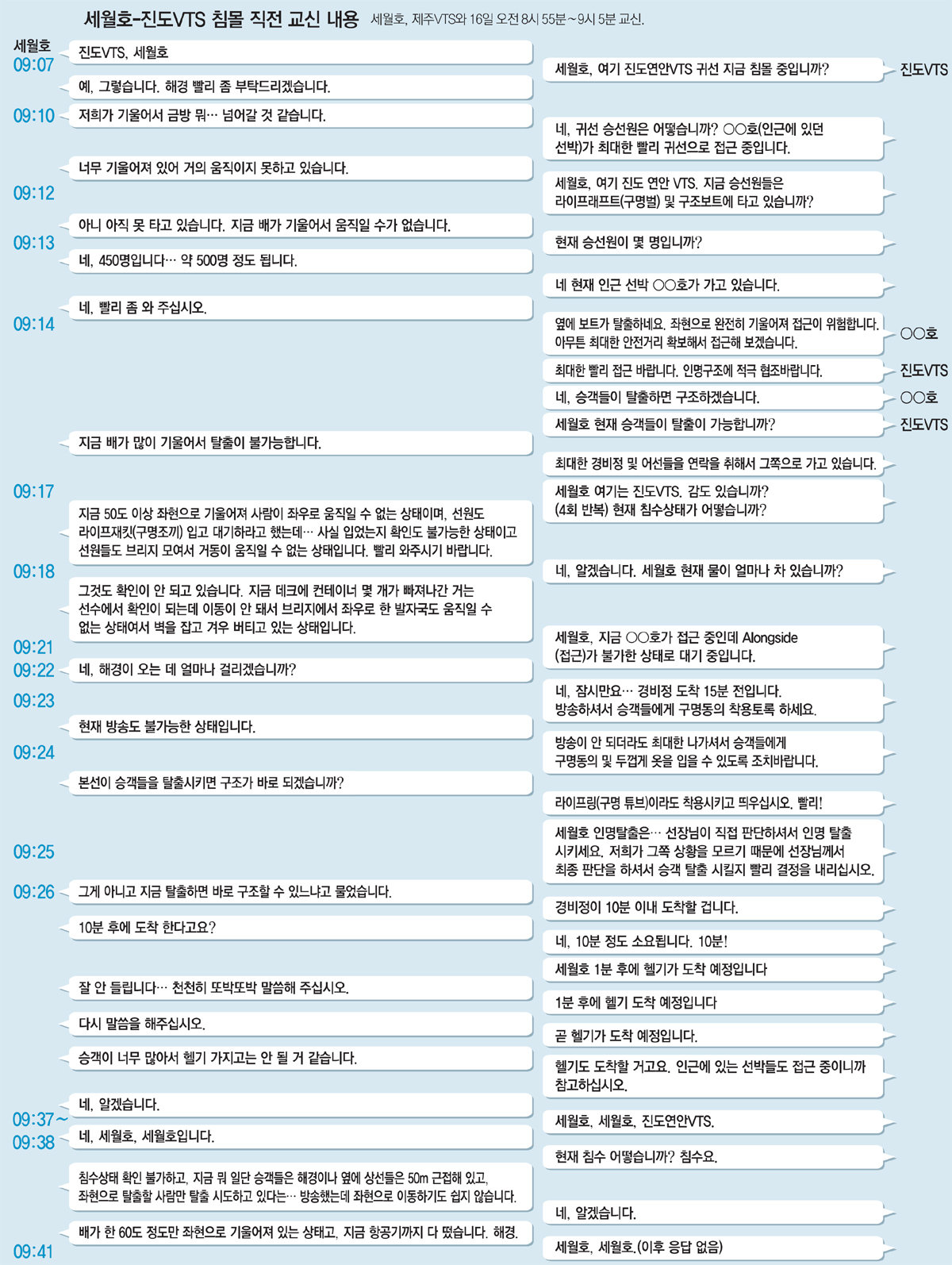
When the Jindo VTS told the Crew to make the announcement to the passengers to put on life jackets, the Crew lied and said the PA system was out. When the Jindo VTS told the Captain at 9:25 a.m. to "put out life boats, use your judgment and make the decision to evacuate ship," the Crew replied with a non-sequitur:  "if we evacuate now, will there be a rescue right away?"

The Government

Once Jindo VTS began communicating with the Sewol, it acted reasonably well. It did order the Captain to deploy the life boats and evacuate the ship based on his judgment. Given that the VTS had no visual of the exact situation, it seems like an unfair, 20/20 hindsight claim to say that the VTS should have been more forceful in ordering the Captain to evacuate.

However, Jindo VTS did fail to do one thing it reasonably could have done:  take an accurate stock of the situation, and relay the information to the rescue team that was heading to the Sewol. To be fair, the VTS asked the Sewol how much water it was taking on, and whether the passengers could escape. But it could have asked more pointed questions:  where were the passengers? Did they jump into the water? Huddled at the deck? Still inside the ship?

THE PARTIAL RESCUE

The Sewol sinks, with most of its passengers trapped inside.
(source)
The Crew

At 9:35 a.m., the Coast Guard rescued the first group of people from the Sewol. As it is now infamously known, the Crew escaped first, before everyone else on the ship. Critically, the Crew never announced to the passengers that they must evacuate the ship. The junior crew, below the top deck, was left to fend for their own. They heroically saved many passengers before they themselves perished.

Initially, the Captain claimed during the investigation that he did order to evacuate before he escaped. Text messages from the passengers, sent after the Captain's escape, showed that it was a lie. Afterward, the Captain said he was concerned that the passengers would not survive if they exited the ship because the water was too cold and too fast and there was no rescue ship around. If you are wondering if that explanation makes sense, don't.

The Company

At 9:38 a.m. an employee of the Cheonghaejin Marine Co. placed a call to its field office at the port of Incheon. The employee, who is now under investigation, called to tell the field office to destroy evidence of the fact that the Sewol was vastly overloaded with cargo.

The Government

The Coast Guard first responders deserve high praise for arriving as quickly as they did. The first responders, however, had no idea about the specifics of the situation because no one asked. The first responders said when they arrived at the ship, they were perplexed that there were not a ton of people in the water already. But the urgency of the situation made the Coast Guard focus first on taking the people who were ready to get out. (And of course, the people who were most ready to board the Coast Guard rescue boat was the Crew.)

For the passengers--mostly young students--who were not lucky enough to run into the junior crew frantically running to save as many people as they could, the last official instruction they heard was to stay in their cabins. The Coast Guard's helicopter did blare through the bullhorn, telling the passengers to evacuate, but the sound did not travel far enough inside the cabins. (Also, many of the passengers were simply not in a position to escape, as the part of the ship in which they were located had already listed too much.) Had the Coast Guard known that hundreds of passengers were still inside the ship, or that the Crew never told the passengers to evacuate, they may have made a different decision and ventured into the inside of the ship, saving more people.  -EDIT 2015/04/15- Because of additional information uncovered since the accident, the preceding sentence is no longer true. Please refer to this update post for additional information. Although it would have been very dangerous for the Coast Guard to approach the main cabin door, it was not impossible.

Ultimately, it came down to the fact that the rescue team simply did not have enough time. The Coast Guard began the rescue at 9:35 a.m. Slightly more than 20 minutes later at 9:56 a.m., the Sewol had listed 90 degrees on the left side, trapping everyone on the left. At 10:06 a.m., the Coast Guard saw passengers screaming inside a ship's cabin. The Coast Guard broke the window, and rescued seven passengers from inside the cabin. Those seven were the only ones rescued from inside the ship. The Coast Guard had no divers, and not enough people to keep breaking glass.

The last text message from inside the ship, sent by a Danwon High School student, was transmitted at 10:17 a.m. At 10:31 a.m. the Sewol capsized completely, taking everyone inside with it.

*              *              *

Part III will discuss how various political and social actors of Korea, including the disaster managers, the President, politicians, the media, and ordinary citizens reacted after the sinking of the Sewol.

Got a question or a comment for the Korean? Email away at askakorean@gmail.com.