Happy Chuseok!

The Korean wishes everyone happy chuseok. Hopefully, nobody is being stuck in a traffic like this one:

Chuseok traffic, circa 1993
(source)

Enjoy your time with friends and family, and enjoy the full moon.

Got a question or a comment for the Korean? Email away at askakorean@gmail.com.

Get Down, Get Down to the Floor

Dear Korean,

Why do Koreans sometimes sleep on the floor? I mean they just put a mattress on the floor and that's it. But sometimes, they sleep in a regular bed. Why is that?

Gabriela


What's "regular" to you may not be "regular" everywhere in the world.

Until recently--that is, until approximately 30 years ago--the "regular" way to sleep in Korea was to sleep on the floor. Koreans would usually have a very large wardrobe, in which they kept their bedding. The bedding would be comprised of a thick blanket/mattress (about as thick as a thin futon,) which was placed on the floor. One would sleep on that blanket (called 요 [yo],) with a lighter blanket on top for warmth. Every morning, Koreans would wake up, fold the two blankets and put them into the wardrobe; every night, they would take them out again and make the bed.

Modernity and convenience eventually phased out this habit. The Korean is actually old enough to remember the time when few Koreans slept on a bed. He himself never slept on a bed until he was in the third grade, i.e. 1991, when the Korean Mother decided to sign onto the ongoing fad--and the Korean Family was somewhat ahead of the curve. (It took him nearly two weeks before he did not fall out of the bed every night.) Hotels used to give the guests an option to choose between a "bed" room, or a "floor" room. Yet like everything in Korea, lifestyle habits change very fast. It appears that sleeping on a bed became the mainstream in Korea by mid- to late 1990s. Today, most Koreans sleep on a bed, although sleeping on the floor is not difficult to find in Korea today.

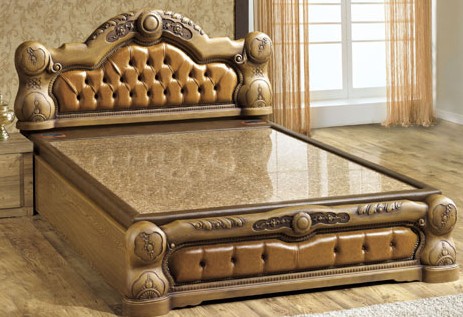
Interestingly, some Koreans found a way to compromise the prevailing trend and the bodily habits. Especially among older Koreans, a "rock bed" has proven popular--literally, a bed that has a sheet of rock instead of a mattress, like this:

(source)
The rock bed often has a heat blanket function for additional comfort. For older Koreans who are accustomed to sleeping on the floor, the rock surface with a blanket on top ends up being just right.

Got a question or a comment for the Korean? Email away at askakorean@gmail.com.

Introducing Reading Korea

Dear readers,

Here is an exciting bit of announcement: the Korean is beginning a new blog, called Reading Korea.

In the seven years that the Korean has run Ask a Korean!, a constant issue has been that readers ask a question that asks for too much, such as: "What should I know about Korean culture?" The Korean's standard answer has been: "I can't write a book for you." While that answer is true, it is not a particularly satisfying answer for either the questioner or the Korean. Fortunately, there are increasingly more books in English about Korea, and more books in English that deal with a particular aspect about Korea in depth. In addition, if one can read Korean, there is a full universe of books regarding every aspect of Korea imaginable. And the Korean reads a lot of books about Korea.

This inspired the Korean to start Reading Korea. Essentially, it is a book review blog about books about Korea. Each review will be kept short, and will also be posted on Amazon.com review if the book is available through Amazon.com. By introducing those books in a single space, the Korean hopes to build toward the ultimate reading list of books about Korea for those who want to learn more about the country in depth. The Korean expects to be a slow process, but that's ok--this blog's modest success came not because there was a great deal of publicity, but because the Korean simply kept writing day by day until more and more people came. Down the line, the Korean is certain that Reading Korea will find its own share of readership.

Reading Korea's first review is already up: Kim Chang-nam's K-POP: Roots and Blossoming of Korean Popular Music. There will be several more book reviews coming down the pipeline in the next few days. Please feel free to visit and poke around Reading Korea, and give any suggestion you may think of.

As always, thank you very much for all your support.

Got a question or a comment for the Korean? Email away at askakorean@gmail.com.
Ask a Korean! Wiki: Language Courses for Children?

Dear Korean,

I would love to go to Korea with my kids and spend about a month in the summer with them occasionally seeing relatives, but mostly I would like them to learn about the culture and language. They are half Korean and sadly speak no Korean but I'm hoping I could change that. Their ages range from 7-12 so a hefty program at Yonsei (which I did as a high schooler many years ago) would not be appropriate, but I'm sure there must be something they can do in Korea to learn the language in a more formal way. Do you have any suggestions?

Tina


The Korean is certain that this type of courses would be in demand, but unfortunately he is not aware of one. (Remember, the Korean never had to learn any Korean.) Readers, got any suggestion? Please share in the comment section.

Got a question or a comment for the Korean? Email away at askakorean@gmail.com.

Women Judges and Prosecutors?

Dear Korean,

How many women judges are there in Korea? And how many female prosecutors are there? Have there been more females since the new president?

Cindy H.


According to Korea Women's Development Institute, 24.4% of the judges and 20.5% of the prosecutors are women as of 2010. There has been a constant increase of women judges and prosecutors in Korea that long pre-dates the new (woman) president. In 2008, for example, more than 70% of the newly appointed judges were women.

Got a question or a comment for the Korean? Email away at askakorean@gmail.com.

Do North Koreans Look Different from South Koreans?

Dear Korean,

Do North Koreans look different from South Koreans?

Ms. Trophy Wife


Short answer: not really.

One thing to remember about North and South Koreas is that they were the same country for a couple of millennia before having split into two countries for the last 60-odd years. So whatever differences that North and South Korea have in terms of language, customs, etc., tend to be minor. For example, the difference in the languages used in both North Korea and South Korea do not amount to more than differences in accent and certain diction, somewhat like the American and Australian English.

Likewise, there is no fundamental difference between the way in which North and South Koreans look. Having said that, however, 60-plus years is not a short amount of time, and the two Koreas did live through two very different worlds. South Koreans now live in one of the world's wealthiest countries, North Koreans one of the poorest. In particular, the crushing famine that North Korea suffered in the mid-1990s has left a visible impact on North Korean people's physique. While the average height of adult South Korean men is 171.5 cm (~5' 7.5"), the average height of adult North Korean men is 165.4 cm (~5' 5"). Because North Korean youths have become so malnourished, North Korea had to lower the minimum height requirement for its soldiers from 140 cm (~4' 7") to 137 cm (~4' 6") in 2010. (In contrast, South Korea recently had to extend the maximum height requirement from 196 cm (~6' 5") to 204 cm (~6' 8") for its conscripts.)

Aside from the difference in physique, the difference in the looks between North and South Koreans is essentially the difference in the wealth available to decorate oneself with fashionable clothing, cosmetics, hair care and (sometimes) plastic surgery. When given the chance to catch up to those additional "boosts," North Koreans--such as these defector ladies from a popular South Korean TV show about North Korean life--look like they will fit right in the streets of Seoul.

Got a question or a comment for the Korean? Email away at askakorean@gmail.com.

Here are Some Korean Slang Terms

Dear Korean,

Does the Korean have a list of colorful Korean language slang?

Cactus McHarris


This is actually a pretty tough task, because the number of slang terms is huge and the types of slang are ever-changing. For a comprehensive overview, the Korean would recommend As Much As a Rat's Tail: Korean Slang, a solid look of old and new slang expressions in Korean. In addition, KoreaBANG's glossary is a decent collection of the latest Internet-slang in Korea.

But the Korean will not simply abdicate this post to book and website recommendations. Although he could not possibly tally all the slang used in Korean language, he can try listing at least a few of them in this space. To that end, allow the Korean to re-introduce his all-Korean language Twitter account:  https://twitter.com/askakorean. The Korean decided long ago that his Facebook account will be for English language content, while his Twitter account will be for communicating with Korean folks--an arrangement that has worked out fairly well so far. And much like the Internet everywhere else, Korea's Twitterverse is full of hilarious slang and memes.

So here are some Korean slang terms ans expressions that went through the Korean's Timeline in the last several days. Keep in mind that this list is far, far from comprehensive, and may become outdated rather quickly. It only contains random samples of some of the slang that the Korean could see in the last several days before he wrote this post. But for curious people, it could be an interesting sampler of Korean slang terms.

The list of slang terms, after the jump.

Got a question or a comment for the Korean? Email away at askakorean@gmail.com.


갑이다 (v.) - to be the best. 갑 is the first letter in the old Sino-Korean counting system.

고고씽 (v.) - to move expeditiously; "go-go-ssing," with "ssing" being an onomatopoeia for moving quickly.

관광당하다 (v.) - to be pwned. Distortion of "강간당하다" (Literally, "to be raped".)
  역관광 (n.) - reverse pwnage. 

개고생 (n.) - very arduous endeavor, often unnecessary; literally, "dog endeavor".

개소리 (n.) - an utterly wrong statement; literally, "dog noise".

겁나 (adv.) - very. Contraction of "겁나게". (Literally, "scarily").

게거품 물다 (v.) - to be extremely upset; literally, "to foam at the mouth like a crab" 

괜춘하다 (v.) - to be ok; to be decent. Distorted form of "괜찮다".

까다 (v.) - to criticize; literally, "to kick".

꼰대 (n.) - a pedant; an annoying person who gives condescending lectures.
   Related:  꼰대질 (n.) - being a pedant.

꿀잼 (v.) - to be extremely fun. Contraction of 꿀맛같은 재미 (literally, "fun that tastes like honey").

남주 (n.) - male main character (in a novel, drama, movie, etc.). Contraction of 남자 주인공.
   Antonym:  여주 (n.) - female main character. Contraction of 여자 주인공.

넘 (adv.) - very. Contraction of "너무".

네임드 (adj.) - well-known. Korean pronunciation of "named", originates from MMORPG games that have "named weapons," i.e. unique and particularly strong weapons.

드립 (n.) - a joke. Contraction of "애드립 [ad lib]".
   Related:  드립력 (n.) - the ability to make jokes.
   Related:  드립치다 (v.) - make a joke.
   Related:  개드립 (n.) - a bad joke; literally, a "dog" joke.

땡기다 (v.) - to want. Distortion of "당기다" (literally, "to pull").

레전설 (n.) - a legendary story. Combination of "레전드 [legend]" and 전설.

멘붕 (n.) - (mental) devastation. Contraction of "멘탈 [mental] 붕괴".

뭥미 (int.) - "What?" Distortion of "뭐임?" ["What's this?"]

발리다 (v.) - to be pwned. Literally, "to be smeared (like butter)" or "to be flayed".

부심 (n.) - pride that is often excessive and unnecessary. Contraction of "자부심".
   Related:  슴부심 (n.) - pride held by women with big boobs. Contraction of "가슴 부심".

뻘짓 (n.) - dumb action.
   Related:  뻘트윗 (n.) - a dumb Tweet.

삽질 (n.) - dumb, useless action. Literally, "shoveling".

생축 (n.) - "Happy birthday". Contraction of "생일 축하".

솔까말 (adv.) - "to be completely honest." Contraction of "솔직히 까놓고 말해서".

시전하다 (v.) - to act or demonstrate, usually with mock ceremony

썰 (n.) - a story.
   Related:  썰 풀다 (n.-v.) - to tell a story. Literally, "to unravel a story."

안습 (adj.) - sad, pathetic. Contraction of "안구에 습기" (literally, "humidity in the eyeball", i.e. tearing up.)

야설 (n.) - a pornographic novel. Contraction of "야한 소설" (literally, "obscene novel').

어그로 (n.) - deliberate provocation, usually to spark an argument. Contraction of "aggressive" or "aggression".
   Related:  광역 어그로 (adj.-n.) provocation that aims at a great number of people, either by picking on a sensitive topic or by insulting a large group of people.

오덕후 (n.) - a nerd, with an unusual and specific area of interest (e.g. Japanese animation); Koreanization of "otaku"
   Synonyms:  덕후 (n.); 오덕 (n.); 덕 (n.). Contraction of "오덕후"
   Related:  십덕 (n.) or 씹덕 (n.) - a particularly nerdy nerd. Play on the word "오덕," which can be read as "five 덕" (while 십덕 can be read as "ten 덕").
   Related:  덕력 (n.) - breadth of knowledge in the area of geekery; literally, "nerd power".
   Related:  양덕 (n.) - Western nerd.
   Related:  밀덕 (n.) - nerd focusing on military weaponry. Contraction of "밀리터리 [military] 덕후". 

야매 (n.) - bootleg; fake or black market product.

염장 (n.) - kicking when someone's down; salting the wound. Literally, "salting".

이뭐병 (int.) - "What the hell?". Contraction of "이게 뭐야 병신아" ["What is this, you moron?"]

이빨까다 (v.) - to banter, usually in smart aleck; literally, "to uncover teeth".
   Related:  이빨 (n.) - smart aleck-y banter; literally, "teeth".

잉여 (n.) - a jobless, useless person; literally, "leftover".
   Related:  트잉여 (n.) - a useless person who spends too much time on Twitter. Combination of 트위터 ["Twitter"] and 잉여.

작업 (n.) - flirting. Literally, "work" or "operation".

좆 (n.) - penis.
   Related:  좆같다 (v.) - to be bad (as in quality).
   Related:  좆만하다 (v.) - to be little; literally, "as little as a dick."
   Related:  좆밥 (n.) - an insignificant thing; literally, "dick feed."
   Related:  좆나 (adv.) - very. Also distorted into 존나 or 조낸.
   Related:  좆까 (v.) - to fuck off; literally, "peel a dick." Also distorted into 조까.

재미지다 (v.) - to be fun.  Distortion of "재미있다".

짤방 (n.) - a picture. Contraction of "짤림 방지" (literally, "cut prevention"). Originated from a popular web community called DC Inside, which began as a digital photo sharing site. Because DC Inside would delete a post without a picture (as it was contrary to the purpose of the site,) people who frequent DC Inside to write about topics other than photography began adding just any photo.
   Synonym:  짤 (n.) - contraction of 짤방.
   Related:  혐짤 (n.) - disgusting or gross picture. Contraction of "혐오스러운 짤방" [disgusting 짤방]
   Related:  움짤 (n.) - moving gif. Contraction of "움직이는 짤방" [moving 짤방]
   Related:  먹짤 (n.) - picture of food. Contraction of "먹을 것 짤방" [food 짤방]

쩔다 (v.) - to be awesome, either in quality or scale.

천조국 (n.) - America. Literally, either "heavenly kingdom," a term that old Korea referred to China, to which it was a vassal state, or "the one trillion country," referring to the fact that U.S. annual budget is more than KRW 1 trillion.

최애캐 (n.) - favorite character; favorite person. Contraction of "최고 애정이 가는 캐릭터 [character]", originally used in the context of video games involving a lot of characters.

츤데레 (n.) - a shy and cold person who secretly has a heart of gold. Korean pronunciation of "tsundere."

칼침 (n.) - stabbing; "knife acupuncture".
   Synonym:  칼빵 (n.) - stabbing

케바케 (adj.) - case-by-case. Contraction of "케이스 바이 케이스".

퉁치다 (v.) - to call it even.

후죠시 (n.) - woman who likes gay men; Korean pronunciation of "fujoshi"
   Synonym:  후죠 (n.) - Contraction of "후죠시".
   Related:  후죠물 (n.) - movies, dramas or comics featuring gay men, aimed toward 후죠시 women.

흑역사 (n.) - embarrassing personal stories of the past; "dark history".

Got a question or a comment for the Korean? Email away at askakorean@gmail.com.