Korea's Labor Productivity, and How to Interpret Data About Korea

An article titled Seven Reasons Why Korea Has the Worst Productivity in the OECD, from March 2014, has been recently making rounds in TK's Facebook feed again. It was a dumb article at the time of the publication, and it remains dumb today. Regardless, the article continues to receive approving reactions--which merits pointing out exactly what is dumb about this article.

First, the article itself. The author Michael Kocken, writing for Business Korea magazine, begins with this:
Korea was recently named the worst place for worker productivity in the OECD, which was featured in a recent article by this magazine. This news is not surprising for any professional previously or currently working in Korea, as the notorious overtime hours coupled with years of low growth have been a widely-discussed issue over the past few years.
Then the article makes the familiar, banal complaints about Korea's corporate culture:  Korea's corporate structure is too rigid and hierarchical; there is no honest and direct communication; worker distraction from the Internet and smartphones; hungover workers, valuing form over substance, new workers who are poorly equipped, and the need to put in useless "face time."

Typical office scene in Korea. Is this the home of low productivity?
(source)

What's dumb about this article?

First, the article's starting premise is flatly untrue. Korea's labor productivity was not the worst in the OECD. Korea's labor productivity per worker in 2012 (which was the most recent data available as of the article's writing) was at 23rd place among the 34 OECD member states. Sure, 23 out of 34 is still in the lower range. But it is a far cry from being at the worst place.

But let's be generous and make an ample allowance between the bottom third and the rock bottom. After all, it would be good for Korea to aspire to be on the above-average side of the OECD. However, even this allowance cannot save this article. The main problem with the article is that the author does not seem to understand what "labor productivity" means. This is apparent from the second sentence of the article's opening paragraph, which refers to Korea's long overtime hours. Even setting aside the factual inaccuracy that TK noted earlier, this is a strange statement.

Why is it strange? Because OECD measures labor productivity by, essentially, dividing "output" by number of hours worked. (The precise methodology is somewhat more complicated, especially on how one defines "output." If you are interested in the actual methodology, you can find it here.) This necessarily means that the longer one works, the lower the labor productivity, because if you increase the denominator while holding the numerator at the same level, the result is always a smaller number. In other words, Korea's labor productivity is low because of long overtime hours, not despite the overtime, as Kocken appears to imply.

This leads us to the most important lesson:  what OECD means by "labor productivity" is not what an ordinary person would think. When OECD states Korea has low labor productivity, the word "productivity" is not being used in the same manner in which regular people talk about being "productive at work." But the latter is exactly how the author Michael Kocken uses the term "productivity." Then the article simply runs with the incorrect understanding of the term, and make the trite, stereotypical complaints about Korea's corporate culture.

(More after the jump.)

Got a question or a comment for the Korean? Email away at askakorean@gmail.com.


Well then. If Korea's low labor productivity doesn't mean what a regular person may think it means, what does it actually show?

Korea's low labor productivity shows that the value creation in Korea's economy is heavily concentrated. The OECD report that focuses on Korea makes this very clear (at pp. 4-5): Korea's labor productivity is excellent in areas for which Korea is known, and very poor in other areas. Specifically, Korea's labor productivity in manufacturing is world-class, while labor productivity in service industry is below par. (As of 2010, labor productivity in Korea's manufacturing sector ranked second in the OECD.) In fact, labor productivity in Korea's service industry is only half as much as that of Korea's manufacturing industry. This ends up dragging down the whole of Korea's labor productivity per worker, because over 70 percent of Korean workers work in the service industry.

Why is the labor productivity in Korea's service industry so low? There are largely two reasons. First, unlike Korea's manufacturing industry, Korea's service industry does not compete in the global market. For example, Korea's legal industry was a closed market until very recently; foreign law firms will not be able to fully operate in Korea until 2017. Same is true for Korea's medical industry, whose market will not open to international hospitals until much later, if it ever does. Absent world-class competition, it is not a surprise that Korea's service industry does not have world-class labor productivity.

Second reason is that the Korean economy has an inordinately huge number of mom-and-pop shops, which technically belong to service industry. One of TK's favorite Korea trivia is:  Korea has 12.2 restaurants per 1,000 people, whereas Japan only has 5.7 restaurants per 1,000 people and the United States has 1.8. As much as Koreans love their food, gastronomical pleasure alone does not explain why Korea has nearly seven times more restaurants per capita than Americans do.

Because Korea has had a weak social security network, few Koreans could truly afford to "retire"--that is, take their savings, add them with governmental assistance, and stop working. Instead, upon "retiring" from their initial career, most Koreans have to take their savings and open up their own business to generate enough money to get through old age. This leads to a proliferation of restaurants, a business with pretty low initial barrier to entry. In particular, franchise restaurants--which are very easy to open without much experience--makes the barrier to entry even lower. (By the way, this is a large part of the reason why Korea has so many different fried chicken restaurants everywhere.)

And of course, this trend is hardly limited to restaurants: as of 2011, 28.2 percent of all Korea's workers were self-employed, which is a huge proportion compared to the OECD average of 16.1 percent. (In fact, the same number for Korea in 2010 was eye-popping 36.8 percent.) Such mom-and-pop shops naturally have low labor productivity, because the hours tend to be long and the value created tend to be small. And there are far too many of them in the Korean service industry.

The low labor productivity of the mom-and-pop shops weighs down the labor productivity of the entire service industry, which in turn weighs down the overall labor productivity of the Korean economy. This is arguably the most important reason why Korea tends to have low labor productivity.

*                   *                   *

The lesson here is simple: be diligent. If you are going to write about data regarding Korea, actually look at the data. Let the data speak, instead of inserting your own bias.

As shown above, OECD's labor productivity has nothing to do with Korea's corporate culture. If Korea's corporate culture were dragging down Korea's labor productivity, one should expect to see that drag across all sectors. But data says that is not true. Korea's manufacturing sector has world-beating labor productivity--and it is not as if Korea's manufacturing giants (e.g. Samsung, Hyundai, LG) are known for their touchy-feely lack of hierarchy. Having accurate knowledge about what labor productivity indicates, leads to the accurate conclusion:  if Korea is good at something, it has excellent labor productivity in that area; if Korea is not as good, its labor productivity in that area is poor. Simple as that.

Do you think Korean work culture is too hierarchical, to Korean economy's detriment? Fine, make that argument. TK is skeptical of the claim that the corporate culture which created a world-beating manufacturing sector can be a problem somehow, but he is willing to entertain a good argument to the contrary. Find actual data that supports your contention, and we will have a debate. But don't bring in irrelevant data because it kind of sounds like the thing you are going for--because that's just lazy, and laziness is what often leads to dumb articles like this one.

Got a question or a comment for the Korean? Email away at askakorean@gmail.com.

Korea and the Great War


Dear Korean,

Since the centennial anniversary of the First World War (1914-2014) is upon us, it would be worthwhile to ask: (1) How did the First World War affect Korea? (2) Is the "War to End All Wars" studied in any detail by Korean students today?

Trenchman


For the centennial anniversary of World War I, TK recommends everyone to visit Kansas City, Missouri, a deeply underrated city in his opinion. There, after having some of the world's finest barbecue, visit the National World War I Museum, which houses a relatively small but all-around-awesome collection related to the Great War. Fans of history and military equipment can easily spend an entire day there. TK had a wonderful time visiting.

National World War I Museum at Kansas City
(source)

But enough gratuitous plugging. How did the First World War affect Korea? Short answer:  it didn't. Speaking of World War I is a bit like speaking of the World Series--we all know what the terms are trying to say, but they do not really mean what they say. The supposed "World" War barely grazed East Asia. Sure, Australia and New Zealand engaged in some land battles in the then-German Samoa, and the Japanese laid siege to the German base in Tsingtao, China. (Fortunately, the Germans stuck around just long enough to teach the locals how to make proper beer.) But in East Asia, World War I was never an all-out war that affected the daily lives of most people. This was true in Korea as well.

The aftermath of World War I, however, did play a significant role in Korea. On January 8,1918, toward the end of the war, President Woodrow Wilson gave the famous Fourteen Points speech, in which he advocated for (among other things) national self-determination, i.e. the right of the colonized people to free themselves from imperialism and form their own national government. 

(More after the jump.)

Got a question or a comment for the Korean? Email away at askakorean@gmail.com.


To be sure, Wilson's version of national self-determination did not directly pertain to Imperial Japan--which was, at the time, part of the Allied Powers along with the United States. The Korea Independence Movement activists who hoped to make a case for Korean independence at the Paris Peace Conference (which took place shortly after the Fourteen Points speech) were shut out from the meetings. Wilson promptly ignored the petition suing for Korean independence that Syngman Rhee (who would later become South Korea's first president) sent to the White House as the representative of the Korea Independence Movement.

Regardless, the grand vision of national self-determination served as great inspiration for the colonized Korean people. The result was the March First Movement, the largest mass independence movement in the colonial period. Every major Independence Movement activist, located not simply within Korea but in Japan, China and the United States, collaborated to promulgate the Declaration of Independence. 

March 1st Movement near Gwanghwamun [광화문].
(source)
On March 1, 1919, the 33 Independence Movement leaders read the Declaration aloud in Seoul, which marked the beginning of a massive protest that lasted for months. Depending on the sources, between a million and two million Koreans marched for independence. In the following crackdown by Imperial Japan, thousands died. Until the colonial rule ended in 1945, March 1 Movement would mark the largest mass movement for independence.

Got a question or a comment for the Korean? Email away at askakorean@gmail.com.

50 Most Influential K-pop Artists: 9. Shin Hae-cheol

[Series Index]

9. Shin Hae-cheol [신해철]

Also known as:  Shin Hae-chul; Crom

Years of Activity: 1989-present 

Discography:  

As vocal/keyboard of Muhan'gwedo [무한궤도]
When Our Lives Come to End [우리의 삶이 끝나갈 때] (1989)

As a solo artist
Shin Hae-cheol [신해철 1집] (1990)
Myself (1991)
Crom's Techno Works (1998)
Monocrom (1999)
The Songs for the One (2007)
Reboot Myself Part 1 (2014)

As vocal/keyboard of N.Ex.T
Home (1992)
The Return of N.Ex.T Part 1: The Being (1994)
The Return of N.Ex.T Part 2 (1996)
Lazenca: a Space Rock Opera (1997)
The Return of N.Ex. T Part III (2004)
Re:Game (2006)
666 Trilogy Part 1 (2008)

As a member of NoDance
Golden Hits (1996)

As a member of Wittgenstein
Theatre Wittgenstein (2000)

Representative Song:  To You [그대에게] from When Our Lives Come to End


그대에게
To You

숨가쁘게 살아가는 순간 속에도
Even in the hectic living moments
우린 서로 이렇게 아쉬워하는 걸
We still want each other more
아직 내게 남아있는 많은 날들을
The many days that I still have left
그대와 둘이서 나누고 싶어요
I wish to share them with you

내가 사랑한 그 모든 것을 다 잃는다 해도
Even if I lose everything I have loved
그대를 포기할 수 없어요
I cannot let you go
이 세상 어느 곳에서도
No matter where in the world
나는 그대 숨결을 느낄 수 있어요
I can feel your breath
내 삶이 끝나는 날까지
Until the day my life ends
나는 언제나 그대 곁에 있겠어요
I will always be by your side

Translation notes:  "숨가쁘게 살아가는 순간" is weirdly difficult.

In 15 words or less:  The most significant Korean rock musician of the 1990s.

Maybe he should should be ranked higher because...  Both in terms of music and in terms of social participation, how many K-pop artists tried more different things than Shin did?

Maybe he should be ranked lower because...  How much direct influence did Shin have? How much in the current K-pop scene can be definitively traced back to Shin Hae-cheol, like the way in which one can definitively trace Korean hip hop back to Drunken Tiger?

Why is this artist important?
As we climb higher into the rarefied heights of Korean pop music history, a concise statement of an artist's importance is approaching ever closer to impossible. One could easily write a book about Shin Hae-cheol's career; unfortunately, we can only spare a few paragraphs here.

From the beginning, Shin Hae-cheol's musical career portended a daring, experimental musical vision. Shin debuted with his band Muhan'gwedo ("Infinite Track") on the Campus Song Festival, the scene-defining audition show at the time. The crackdown from Korea's dictatorship (which ended only a year before Shin Hae-cheol's debut) has neutered K-pop, making the saccharine and brain-dead soft rock (locally referred to as "ballads") the mainstream genre. But Muhan'gwedo would have none of it. Reversing the conventional pop progression that gradually built up to a climax, To You opens with a dramatic, synthesizer-induced flair and rushes full speed toward the finish line.

Shin Hae-cheol then debuted as a solo artist, engaging in a brief (and embarrassing-in-hindsight) stint of idol pop at the insistence of his record company. Then Shin finally found his musical homeland by forming N.Ex.T. (pronounced "next",) the most significant Korean rock band of the 1990s. Looking at the current K-pop scene in which idol pop has overrun the market, it is difficult to believe that a rock band like N.Ex.T. used to top the K-pop charts. But it is true. Led by Shin Hae-cheol, N.Ex.T stood firm on the foundation of progressive rock yet struck in all directions: heavy metal, thrash rock, electronica and Korean traditional music. Shin also put project albums as an individual (taking on a separate stage name of "Crom",) trying ever more daring sound and demanding the audience to simply get used to it.

But Shin Hae-cheol's musical achievement is only half of his story, as Shin is arguably one of the most socially active pop musician in K-pop history. Perhaps betraying his elite education (Shin attended Sogang University, one of Korea's top five colleges,) Shin maintained a sharp tongue that relentlessly criticized the Korean society's irrationality and hypocrisy as a proper rocker should. Shin Hae-cheol led the charge in the movement to repeal the Korean law that prohibited two people with the same last name from getting married. Shin was also the leader of the now-infamous concert in 2002, in which Psy (of the Gangnam Style fame) performed an anti-American rap number, to express his anger at the death of two young Korean girls who were run over and killed by an USFK armored car.

The best pop artists do not simply influence the artists who come after them; they change the society around them. By that measure, Shin Hae-cheol is about as influential as any in K-pop history.

Interesting trivia:  Shin Hae-cheol is often mistaken as being related to the legendary Shin Jung-hyeon [신중현], as the name of Shin Jung-hyeon's oldest son is Shin Dae-cheol, leader of the influential heavy metal band Sinawi. Shin Hae-cheol, however, bears no relation to Shin Jung-hyeon. Shin Hae-cheol is, however, a blood relative to a different K-pop legend: Shin is the second cousin of Seo Taiji. Reportedly, the two are close, often seen together fishing or skiing.

Further Listening:  A.D.D.a. from Reboot Myself Part 1, song recorded entirely as a one-man a capella.

Got a question or a comment for the Korean? Email away at askakorean@gmail.com.

Law and Economics of Korean Street Food

Dear Korean,

I am living in the southern part of South Korea. One of the things I love about Korea is the street vendors selling food. Do these street vendors get a license or do they just set up shop? Also the 'shops' tend to close in the summer. For instance, I love 붕어빵, but they only sell during the winter. Why? Meanwhile in Seoul the street meat people are out all year long, usually at night. Why do they wait to set up at night? Why isn't street meat seasonal?

Debbie

Long before the American hipsters turned the food truck into a fad, Asians have figured out the romance associated with eating on a mobile platform.

Typical street cart food setup in Korea.
(source)

But behind the delicious, delicious hunger-inducing facade, the legality and economics of street vendors in Korea are pretty complex. Conclusion first: technically, one must obtain a license--which comes with regular health inspections--to open up a street cart. But it is fair to say that the law is observed only in select parts of Korean cities. Street carts in areas with huge foot traffic, and those that sell alcohol tend to invite more scrutiny, because of the various potential public hazard (mass-scale food poisoning, drunken brawls) they pose. In areas with regulation, the street cart owners often form an association to conduct their businesses in an orderly manner. There is even a secondary market in which the license-holders buy and sell the government licenses.

Outside of those areas, however, anything goes. This is directly related to the character of street vending as a business. Street vending has very low entry barrier. At the lowest possible end, one only needs a floor mat and some home-made gimbab [김밥] to be a street vendor. Even a more sophisticated street food vendor rarely requires more than a truck carrying a makeshift kitchen which, in the grand scheme of business, is not a huge capital investment. In fact, there are many businesses that rent out the street-vending equipment, and provide the mass-produced, half-cooked food that the street vendors only have to heat up and serve. (Oh come on, don't act all surprised.) This serves to further lower the entry barrier into the street-vending business by lowering the cost, and by eliminating the need to learn whatever technical expertise necessary to cook up the food.

Because the entry barrier is low, street vending is an attractive option for numerous Koreans, many of whom are economically down-and-out. This makes the government reluctant to crack down on them very strongly. The local government will act if a street vendor creates any issue that causes complaints from the residents. But most vendors are wise enough to fly under the radar, and the locals are generally happy to pick up some 붕어빵--a fish-shaped pastry with sweet red bean filling--on the way home from work. (In fact, the people who file the most complaints against street vendors are other street vendors, who frequently use government regulation as another weapon in turf war.)

Why are some types of street food seasonal, and others available year-around? Much of it has to do with the fluctuating demand. The demand for chicken on a stick, for example, remains the same year-around. But certain types of street food--like 붕어빵, roasted chestnuts, roasted sweet potatoes--are strongly associated with autumn and winter. Because there is more demand for such food during a limited time frame, many street vendors jump into selling these cold-weather snacks to make a quick profit, and exit the business when the weather warms up.

A world with little to no regulation, in which entrepreneurs freely enter and exit to precisely meet the dynamic demand of the market? Maybe Korean street cart market is the dream of the laissez-faire capitalist.

Got a question or a comment for the Korean? Email away at askakorean@gmail.com.

Divided Sports Loyalty?

Dear Korean,

I am Chinese American, immigrated at 4 years old. I identify very much as an American and while I want China to do well in competition, I will generally root for the USA over China head to head. A Korean American friend of mine shared this article, which I thought was very interesting. It advocates that Korean immigrants, as immigrants and people assimilating into American culture, have an obligation to not root against their new home country. What do you think?

John L.

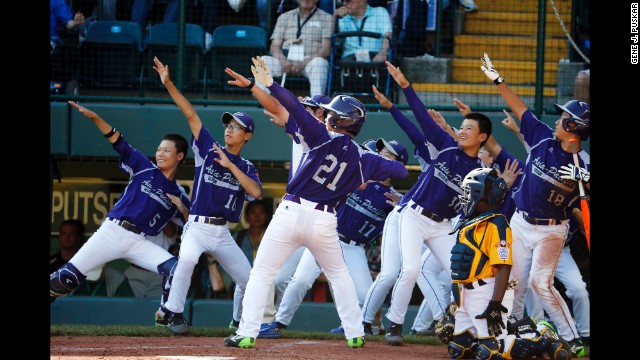
Given the recent duel between Team Seoul and Team Chicago in the Little League Word Series, TK figured this would be a good topic to address. As immigrants, where should our sports loyalty lie?

Give it up for the good-lookin' World Champions.
(source)
The article that John L. shared outlines a common perspective. An excerpt:
When we as Korean Americans don Korea shirts and wave Korean flags during Korea-USA games, we are not choosing a team, we are choosing a nation. We are very deliberately and purposely choosing to support a foreign nation against the one we call our home and protector. It’s true that issues of identity are more complex – many of us feel just as much at home in Seoul as we do in San Diego or Daegu as in Dallas, but there are times when we cannot conveniently declare that we are “citizens of the world”, or “both Korean and American.” There are hard choices to be made.

It is ironic and inconsistent for us to complain of being seen as “perpetual foreigners” and having to struggle to be accepted as Americans, and then turn and root against America when the choice comes. And we cannot be truthful to ourselves and say that Korea’s games against the US are only sport when we consider Korea’s games against Japan as so much more. Culture plays an enormous role in setting the framework for people’s understanding of the world around them.

During World War II Asian Americans proudly and publicly made efforts to support America, despite the outrageous Executive Order 9066. Many, facing discrimination, wore buttons that read: “I am an American.” Still others, like Colonel Young Oak Kim, wore America’s uniform and served abroad. The Asian American 442nd Infantry continues to be the most highly-decorated military unit in the history of the American armed forces.
Undoubtedly, many people take this view, as many people take sports quite seriously--as does TK. So what does he think about this case of "divided loyalty"?

(More after the jump)

Got a question or a comment for the Korean? Email away at askakroean@gmail.com.


First off, let me tell you just how big of a sports fan I am. Here are just some of the stupid things that I have done for the sake of sports.

- In my high school years, I was in a massive car accident that completely destroyed my car. The car was literally towed straight from the site of the accident to the junkyard. I did not have any externally visible injury, but I very well might have had severe internal injury and/or spinal cord damage. But I adamantly insisted that I was not injured at all, and nothing hurt, although I was in a great deal of pain. Why did I lie? Because that was the day when the Los Angeles Lakers played Game 7 of the Western Conference Final against the Portland Trail Blazers, and going to the hospital would have kept me away from the television.

Lakers came back from 13 points down at the start of the fourth quarter to win the game. An alley-oop from Kobe to Shaq, shown below, punctuated the comeback. Watching this lying down on the couch--I was in so much pain I could not sit up--I did a hard fist pump, which sent a searing sensation through my shoulder and arm. But I got to watch one of the greatest moments of Lakers history. I did not regret my decision at the time, and I still do not. (By the way, just in case you are worried: in the end, it turned out that I only had some whiplash and muscle shock.)


- My family and I were traveling in Alaska during a Labor Day weekend, when my dear California Golden Bears would open its football season against the University of Tennessee. We were on a guided tour, and we were scheduled to be in a long bus ride from Anchorage to Fairbanks when the game was on. (This was long before 4G coverage and mobile video, although even today they would not be available in the wilderness between Anchorage and Fairbanks.) 

I was desperate to watch the game. TKFather suggested that I listen the game over the radio. I did not have a radio with me on the trip, and we were staying at a hotel in the outskirts of Anchorage. According to the hotel staff, the nearest place that might sell a radio at 9 p.m. at night is Wal-Mart, which was 20 miles away. Apparently, Anchorage closes early and only Wal-Mart stays open past 9 p.m. 

Did I pay a $70 round trip cab fare to get to that damned Wal-Mart, just to buy a $15 radio that I will never use again for the rest of my life? Of course I did. Listening to the game (which Cal, led by DeSean Jackson, defeated Arian Foster and Tennessee in a 45-31 shootout,) I was alternately giving the play-by-play, singing the Cal fight song, and chanting and screaming incomprehensibly. In a bus full of tourists who couldn't care less.

- I spend so much money on sports that I probably need professional help. I own a jersey and/or a cap of every significant pro sports team from Los Angeles, including David Beckham's LA Galaxy jersey. (Who the hell buys an MLS jersey?) I own two Jeremy Lin jerseys. (It took all my willpower not to buy Lin's Houston one, but how could I not buy Lin's Lakers jersey?) I have so much Cal gear that my friends genuinely wondered whether I owned any piece of clothing that did not have the blue-and-gold logo. I have bought the annual Game Day Shirt for my college every year since I graduated (over ten years ago at this point,) and I plan to buy one again this year. I plan to buy them every year until I die. I don't care if that means I will end up with 50 t-shirts I will wear, at most, once in five years.

When the Lakers make their once-a-year trip to Washington D.C., I always go--although the Wizards bilk fans like me by charging $200 for a crappy seat. (The same seat for, say, a Warriors-Wizards game costs $35.) In fact, I also pay for my friend's ticket because no one else I know is willing to pay that much to watch a basketball game. Same is true when the Dodgers visit the Nationals. Right now, as of this moment TK is writing this post, he is in Chicago to watch the season opener for Cal football against Northwestern University. I did not just use a vacation day at work, pay for the plane ticket and get a rental car (which had to be an SUV, because it is pathetic to have a tailgate on the backside of a Ford Focus--who cares if it costs double?); I paid to overnight sausages from Top Dog, Berkeley's finest hot dog joint, just so I can have the complete Golden Bears tailgate experience. Will I lose my voice around third quarter of the game tomorrow? Absolutely.

*               *               *

All of the foregoing is to make a simple point:  what TK is about to say is not because he believes sports is trivial. This is not going to be a flip dismissal about the importance of sports loyalty, of the kind often given by people who do not understand the value of sports and dismiss it as grown-ups playing with a ball.

For TK understands why sports matter. We sports fans care so much because sports is the most perfect metaphor for life. No novelist, no poet in the history of humankind has created a body of work that even remotely approaches the emotional resonance of a single FIFA World Cup, much less sports in general. Each match is a work of art, reflective of the nuanced highs and lows of the life itself. By watching a game, we experience a birth and a death. We enter the world--the match--with hopes riding high, or perhaps with cynicism and dread. (The latter is a more typical for a Cal Bears fan.) We either achieve glorious immortality by defeating our foe, or experience hell--writ small--by losing in agony. By watching a hundred games, we live a hundred times. 

But it is important to realize that, while sports may be the most perfect metaphor of life, it is not life itself. The endlessly recurring metaphor is possible only because, in sports, we do not actually die in defeat, and we do not actually kill in victory. Sports is so life-like that a significant portion of sports fans substitute their own lives with the sports' representation of life, because often, the latter is much more attractive than the former. This is a mistake. It is one thing to deeply engage in a metaphor, quite another to let it consume reality. When certain lines are crossed, even the most rabid sports fan must be ready to snap out of it. As a Dodgers fan, I am ashamed to see that two Dodgers fans beat a Giants fan after a baseball game in 2011 such that he was brain damaged and permanently disabled. This is what happens when people substitute their lives with a mock-up of a life.

The article that John L. introduced hints that such substitution is starting to happen in the mind of the author of the piece. There is a gaping chasm between an allegiance to the team's name embroidered on the chest of an athlete, and an allegiance to the nation's name embroidered on the chest of your military uniform. Yet the author blithely jumps across that gap by comparing sports loyalty with the Asian American experience during World War II. Even for the most ardent sports fan, such equivocation cannot stand. It does not simply trivialize life by equating a ballgame with a situation in which countless human lives senselessly perish every day for no reason other than their nationality. It also destroys the beauty of sports as a metaphor for life, because sports does not simply represent the current reality, but the reality to which aspire--a world with sportsmanship and fair play. Recall that one of the worst violations of sports fan etiquette is to celebrate the opposing player's injury. But if we should treat our sports opponents as enemies on the battlefield, there is no reason why we should not call for more bean balls to the head, more chop blocks designed to break the knee. 

It is perfectly fine to enjoy sports nationalism, which is a far sight better than an actual war fueled by nationalism. It is also fine to come up with elaborate rules to determine your team, in case there is a possible conflict (as immigrants often do.) TK's personal rules are all over the place: in basketball, he will root for Team USA because basketball matters more in America, but in baseball he will root for Team Korea because he is annoyed that Team USA baseball never fields its best players. The game is not limited to the one unfolding on the pitch; at the end of the day, everyone who is watching sports is participating in a game of a highly elaborate metaphor. Enjoy the game, and don't let it get to your head.

Got a question or a comment for the Korean? Email away at askakorean@gmail.com.

50 Most Influential K-pop Artists: 10. Drunken Tiger

[Series Index]

We are finally in the top ten countdown! Because the top ten musicians usually show a huge spectrum of music that is not sufficiently covered by a single "representative song," TK added a "Further Listening" section at the bottom to give additional examples of the artist's work.

10. Drunken Tiger

Years of Activity: 1999-present 

Members:
Tiger JK - rap (1999-present)
DJ Shine - rap (1999-2004)
Roscoe Umali - rap (2000-2003)
Micki Eyez - rap (2000-2003)
DJ James Jhig - rap (2000-2003)

Discography:  
Year of the Tiger (1999)
The Great Birth [위대한 탄생] (2000)
The Legend of (2001)
Roots [뿌리] (2003)
One is not a Lonely Word (2004)
1945 Liberation [1945 해방] (2005)
Sky is the Limit (2007)
Feel Ghood Muzik (2009)
Let's Live (The Cure) [살자 (The Cure)] (2013)

Representative Song:  You Think You Know Hip Hop? [너희가 힙합을 아느냐] from Year of the Tiger


(Note:  Lines in blue is in English in the original song.)

너희가 힙합을 아느냐
You Think You Know Hip Hop?

[Vocal]
음악 같지 않은 음악을 이젠 모두 다 집어치워 버려야해
Music that is not worth being called "music" has to be all scrapped
우리가 너희들 모두의 귀를 확실하게 바꿔줄께 기다려
We will change all of your ears, just wait

[Rap]
하하 참으로 놀라와 진짜인 우리가 돌아와
Ha ha, truly a surprise, we are real and we have returned
조금씩 너희가 있는 곳에 서서히 올라가
Little by little, we will slowly climb up to where you are
거기 가짜 거기 있어봤자
You there, posers, no point standing there
진짜를 보여줄께 우리가 거기 닿자마자
We will show you what's real as soon as we get there
세상 이상 너무나도 괴상
World is strange, so very weird
너희가 최고라니 그건 너무 환상
You're supposed to be the best? That's too much of a fantasy
우리는 타이거 또한 차원의 차이가 너무 나는 바로 우린
We are Tiger; we are in a different dimension, we are
What! 드렁큰 타이거
What! Drunken Tiger

내 마음에 가득 차있는 나만의 슬픔
The sorrow that completely fills my heart
두 뺨에 타고 흐르는 내 눈물의 의미 너는 알고 있니
Do you know the meaning of my tears, streaming down my cheeks
그렇게 그렇게 힘들고 지쳐 외로워도
Although I'm tired, exhausted and lonely
너희들을 위해 진정한 힙합을 위한 너희들을 위해
For you, for you who stand for true hip hop
나는 꿋꿋이 버텨나가 그렇게 이겨나가
I stand tall, that's how I persevere
한 발 한 발 조금 더 용기를 내 영원한 힙합을 위해서
Step after step, summon a bit more courage for my eternal hip hop
나는 DJ Shine, 영원한 시인 (Number 1 Korean)
I am DJ Shine, the eternal poet (Number 1 Korean)

[Vocal]
눈을 감아 들어봐 온몸으로 느껴진 전율
Close your eyes and listen; the chills that travel down your whole body
주는대로 받아 먹는 건 이쯤에서 그만두어야 해
Time to stop feeding off of what is given to you

You and you W-A-C-K who? 
You and you W-A-C-K who?
Come back home, see me tapping your boo 

[Rap]
하나 같이 꼭두각시
Everyone is a puppet
모두 같은 줄에 매달려서 춤을 추는 슬픈 삐에로
A sad marionette that dances, all hanging on the same strings
이대로 그냥 갈순 없어 슬픈 미래로
We can't just keep marching into this pathetic future
술 취한 호랑이 두 마리 We be coming from ghetto
Two drunken tigers, We be coming from ghetto
진실만 말하는 거리의 시인들
Poets of the streets who only speak the truth
하지만 너의 편견에 빠진 우리 아이들
But our children who is trapped in your bias
인생의 아픔 기쁨 모두 다 들어봐야 해
We gotta listen to all the life's pain and joy
가식으로 엉킨 세상 풀어줘야 해
We gotta untangle the word twisted with hypocrisy

나는 랩퍼 랩퍼
I'm a rapper, rapper
내가 지금까지 살아오고 살아왔던 얘기들을
The stories of how I have lived and lived until now
나는 랩으로 너희들에게 얘기하려 해
I wish to tell you with this rap
이젠 날 지켜주는 건 진정한 힙합의 무대
Now what protects me is the stage of true hip hop
그리고 언제나 밝은 웃음으로 날 반겨주는 사람과 사람들
And the people and the people who always greet me with bright smiles
이제부터 마이크로폰에 나의 영혼을 나의 열정을 남김없이 쏟으리
Now I will give all my soul and passion into the microphone
그리고 진정한 랩퍼가 되리
And I will be a true rapper

Put your hands up 
Put your hands up
All the players in the house put your hands up 
Put your hands up 
Put your hands up
All my Crown-sipping niggas put your hands up
Intoxicated Tiger dropping topics
Hypnotize in illogical melodic sonic, boom up your optic 
Sippin' gin without a tonic, under the disco light I rocked it
Why? It ain't no optical illusion, it's only logic

갑자기 나타나 반짝하고 빛나다가 사라져 버리는 그런 이들과 비교하지마
Don't compare us with some shiny flash that suddenly appears then disappears
우리에게 와 내 앞으로 와
Come to us, get in front of us
힙합을 사랑한다면 다같이 취해봐
If you love hip hop, let's all get drunk

[Vocal]
눈을 감아 들어봐 온몸으로 느껴진 전율
Close your eyes and listen; the chills that travel down your whole body
주는대로 받아 먹는 건 이쯤에서 그만두어야 해
Time to stop feeding off of what is given to you
음악 같지 않은 음악을 이젠 모두 다 집어치워 버려야해
Music that is not worth being called "music" has to be all scrapped
우리가 너희들 모두의 귀를 확실하게 바꿔줄께 기다려
We will change all of your ears, just wait

In 15 words or less:  Undisputed king Korean hip hop (they still call him Tiger you fucking haterz)

Maybe they should should be ranked higher because...  Made hip hop a mainstream genre. What more is necessary?

Maybe they should be ranked lower because...  At the end of the day, how big is hip hop (in its purest form) in Korea?

Why is this artist important?
Development of Korean hip hop is a fascinating story that deserves a closer chronicling. It is a modern case study of how an utterly foreign musical genre spread, took root, and eventually integrated itself into an essential part of the local pop music scene. This process, of course, did not happen by itself. Korean hip hop can be considered a forest, with many a skilled hand that planted, tended and lovingly nurtured each tree. And the credit to the tallest, most majestic tree goes to Tiger JK and Drunken Tiger.

The history of hip hop in Korea arguably dates back to 1989, when a mid-major singer named Hong Seo-beom [홍서범] included a rap track in his album. However, it would take a decade before Korean pop musicians to produce any music that the international audience would recognize as hip hop. The hip hop-esque music from the transitional period of 1990s is sometimes referred to as "rap dance," a genre that is still alive and well in Korea. "Rap dance" is chiefly a dance number, of which varying portions are dedicated to rapping. (This format can easily be seen in the contemporary K-pop idol music.) Although rap dance did much to introduce the Korean audience to hip hop, it still had some distance from hiphop proper, characterized by the rhyme and flow of mostly spoken words over rhythmic beats.

Drunken Tiger was the group that bridged that gap. Tiger JK grew up in Miami and Los Angeles; DJ Shine, New York and Los Angeles. Having cut their musical teeth during the hip hop's "golden age," the two Korean American youngsters were eager to flash their authenticity in the music scene that, in their view, peddled dance music with a false label of hip hop. The provocative title song said it all: "You Think You Know Hip Hop" [너희가 힙합을 아느냐].

Sure, the early attempts were often cringe-inducing in their cheesiness. Drunken Tiger's early emulation of American black culture frequently fell flat. It would take years, and many interceding talents such as Verbal Jint and Leessang, for Korean hip hop to completely overcome the language barrier and create a rhyme and flow in the Korean language--a critical development that finally allowed Korean hip hop to convey a new level of authentic emotion. 

But why does any of that matter? For a very long time, Drunken Tiger was the only K-pop hip hop artist who refused to compromise, releasing album after album filled only with rap rather than taking the easy path of rap dance. It is an overstatement to say that Drunken Tiger single-handedly made hip hop mainstream in Korea. But they did raise a forest from what seemed to be a hostile, infertile land--a feat that required no less fearlessness than any of their American counterparts.

Interesting trivia:  Tiger JK comes from a storied musical heritage. Tiger JK's father Seo Byeong-hu [서병후] is considered Korea's first pop music critic. The elder Seo founded Pops Koreana, Korea's first pop music magazine. He was also the Korea correspondent for the Billboard magazine. Tiger JK's mother Kim Seong-ae [김성애] was a leader of a band called the Wild Cats. Tiger JK then married Yoon Mirae [윤미래], the best female rapper in Korea's rap scene.

Further Listening:  Observe Drunken Tiger's evolution into incorporating parallel rhyming with both Korean and English by listening to Die Legend 2, from Feel Ghood Muzik.

Got a question or a comment for the Korean? Email away at askakorean@gmail.com.

What Makes a Good Korean Restaurant?

TK has been on a vacation for the last week, during which TK and TKWife made a giant circle driving around Colorado, Utah, Arizona and New Mexico, and visited numerous national parks. Overall, it was an amazing experience. What was not amazing, however, was the one Korean restaurant that TKCouple visited, which inspired this Facebook update:
New blog concept: You tell me your favorite Korean restaurant in your town, and I will visit, eat, and tell you everything that's wrong with the food served there.
Inspired by a crappy Korean restaurant in middle America that I'm sitting in. Its walls are covered with awards from local papers, which makes me want to disband those papers.
As TK said in a comment to the update, he won't actually do this. He is a lover, not a fighter, and he certainly knows better than to mess with people's livelihood. However, there is still a teachable moment here. Many people--including many Koreans!--do not really know what separates good Korean restaurants from bad ones. These people simply do not have enough experience to form a frame of reference as to what elements good Korean restaurants have.

Don't just criticize; show the alternative. So TK will give the alternative. Here is a list of things that you should look for in a Korean restaurant in order to tell if it is a good one.

Geographic Location

In U.S.:  Let's be straight. Korean food is not yet at the place where, say, sushi is--that is to say, Korean food is not yet mainstream enough for one to expect a dependable taste for it, outside of the people who grew up eating it constantly. This necessarily means the ceiling for the quality of Korean food sold in areas sparsely populated by Koreans will be rather low. In the U.S., Koreans mostly live in Southern California, New York/North New Jersey and D.C./Maryland/Northern Virginia. (The next tier of Korean American population centers are Northern California, Atlanta, Chicago and Seattle, but the drop-off is significant after the top three.) The quality of Korean food tends to track that order.

In Korea:  Korea is surrounded by seas on three sides, with each side producing different types of fish. Korea's terrain also ranges from mountains to fertile and flat fields, each yielding different types of crops. In short, Korean food is highly diverse based on geography. Because everything in Korea tends to eventually flow to Seoul, the restaurants in Seoul tend to maintain a certain level of quality. But for the real deal, look for the restaurants that sell the food that is made from the local ingredients.

Freshly made soft tofu from Sokcho. This ended up in TK's stomach within minutes.

For example, tofu requires sea water to make. (Bet you did not know that.) Thus, the best tofu comes from Korea's eastern seaboard, in which soy beans grow and the sea water is readily available. Port cities, obviously, are the best places to have fish and seafood. Jeju Island is not only known for its seafood, but also for pork from its native black pigs. Since each locality in Korea loudly advertises its specialty food, it is hard to miss the local delicacy.

Two additional points: (1) in the City of Jeonju, every dish is good; (2) in Daegu, every dish is awful. Just trust me on this. Jeonju is the birthplace of bibimbap, one of the most iconic Korean dishes. In Daegu, locals say the best food available is McDonald's.

(More after the jump.)

Got a question or a comment for the Korean? Email away at askakorean@gmail.com.


Menu

Both in the U.S. and in Korea, this holds true: watch out for restaurants that sell too many different dishes, because every one of the dishes will be mediocre-to-bad. Unfortunately, this applies to vast majority of Korean restaurants in the U.S., because there simply is not enough demand to specialize in certain types of Korean food. In small towns of America, the menu often crosses the border to include Japanese/Chinese/Thai food, creating an unholy alliance of shittiness. Avoid this type of restaurant at all costs.

From the Oatmeal.
(source)

In Korea, restaurants with big menus tend to be in and around train stations and express bus terminals, where many different types of people pass through without particularly caring about the quality of the food available. Avoid these places as well.

The good Korean restaurants serve foods that are related to one another. For example, naengmyeon [냉면, cold buckwheat noodles] ought to be sold alongside with suyuk [수육, boiled meat], because naengmyeon's broth is made of meat. (In other words, do not eat naengmyeon at a place that does not also sell suyuk; it means that the restaurant is using canned broth.) Jokbal [족발, braised pig's trotter] is usually sold alongside bossam [보쌈, steamed/boiled pork with kimchi and cabbage] because they are both pork and they both involve boiling/steaming.

The very best Korean restaurants often serve just one item, like this:

Same tofu restaurant in Sokcho. The entire menu is on the wall:
soft tofu soup, for KRW 8,000 (~$8).

A restaurant has to be awfully confident in what it's selling if it intends to make a business by simply selling a single dish. If you see a Korean restaurant with just one item on the menu, stop by and eat. You will not be disappointed.

Food & Flavor

Majority of Korean food will be in some configuration of rice, kimchi, banchan [반찬, side dishes] and the main dish. Because rice, kimchi and banchan will form the backbone of a Korean meal, the way in which a Korean restaurant handles these elements is a great gauge of how good a Korean restaurant is.

Kimchi:  At this point, there might be a bit too much mystique surrounding kimchi in popular discourse, as if there can be no proper kimchi outside of the kitchen of some old Korean grandmother. Truth is, one can buy pretty decent kimchi from the store--as long as one pays for it. Therefore, kimchi is a decent yardstick to find out whether the restaurant in question has minimum competence. If a restaurant serves bad kimchi, it either does not know what it is doing with food, or does not care enough to buy good food--which includes good ingredients.

There are two major ways in which kimchi can be wrong:  too sweet, or too sour. If either or both is true with a restaurant kimchi, chances are the food will not be good either.

Sweetness is the cancer that is slowly killing Korean cuisine. This cancer is everywhere in Korean food in America, and frequently found in Seoul as well. Gratuitous addition of sugar and MSG (which is also sweet) is ruining the palate of those who did not grow up experiencing the traditional palate. Beyond the subtle sweetness naturally present in the ingredients, Korean food should not be sweet at all. This absolutely applies to kimchi: although napa cabbage and Korean red pepper both bear some natural sweetness, one should be able to tell immediately whether any sweetener was added.

Excessive sourness indicates that the kimchi was improperly made or kept. Kimchi that was properly fermented in the correct temperature has clean, crisp sourness. If fermented too quickly, the sourness becomes overpowering, destroying all the nuances of the dish. Fermentation accelerates if kimchi was kept at a warm place (not a good sign for hygiene) or kimchi has sugar in it. (Excess carbohydrates = hyperactive microbes. To avoid this result, some restaurants choose to add Sweet 'n Low to its kimchi to add sweetness without affecting the fermentation. Vile.)

Note that napa cabbage, which is the main ingredient for the most common type of kimchi, is a winter vegetable. The best Korean restaurants serve kimchi made with seasonal vegetables, not just with napa cabbage. (More on this below.) At least during the winter, cabbage kimchi ought to have a satisfying crunch when chewed, instead of fiber-y toughness. Good kimchi has a strong hint of seafood; cheap kimchi does not, because seafood and fish sauce can be expensive in large quantities.

Rice:  If kimchi tends to show the floor of a Korean restaurant's quality, rice tends to show the ceiling. Most restaurant rice is decidedly mediocre, largely because restaurants usually cook rice in one huge batch, which sits for hours in a giant, industrial-sized rice cooker.

Some restaurants place rice in a stainless steel rice bowl (pictured below) immediately after the rice cooks, and puts the bowl in a warmer. (The bowl has to be made of stainless steel in order to conduct the heat from the warmer--which is why the stainless steel rice bowls are commonly seen in Korean restaurants, but rarely in a Korean home.) Doing this improves the quality of the rice, but only somewhat.

The ubiquitous stainless steel rice bowl.
(source)
The very best Korean restaurants keep numerous small rice cookers, and cook small batches of rice. The rice is served in the traditional porcelain or brass ware--a sign that the rice did not spend any time in the warmer. Good rice is moist enough to have a shiny sheen. Each grain should be intact and visible. One must be able to feel the individual grain when one chews the rice.

To reiterate: good rice is pretty difficult to find in a restaurant. It simply takes too much effort to make each bowl of rice perfect. But this means the restaurant that does put in the effort to serve a good bowl of rice cares about the quality of food it puts out. Good kimchi means the minimum standards are kept; good rice means that you can look forward to the maximal quality.

Banchan:  Kimchi is the minimum; rice is the maximum. Banchan is everything in between.

The number of banchan may vary depending on the main dish. Some main dishes only require two or three. In other circumstances, there may be dozens of banchan dishes, like this:

(Source)

Having a table full of banchan is certainly more impressive than having just two or three. But don't be fooled: restauranteurs also know that big number impresses. They will attempt to impress the customers by having a huge number of banchan that may be old and stale or, worse, buy the banchan from a wholesaler and simply put them on plates. Quantity matters to some degree, but quality matters much more.

Good banchan uses local ingredients. Restaurant in a mountain town should have more vegetables; in a seaport town, more seafood. No matter where the restaurant is, the vegetable banchan has to include more than the three mainstays: bean sprouts, spinach and fern shoots. All things being equal, more seafood in banchan is good news, because seafood is more expensive. Foreign vegetables--like broccoli--have no place on a Korean table. (Don't argue with me about how broccoli might be local to the U.S. It's not Korean. End of discussion.)

Good banchan takes effort. Tossed salad and simple pickles (usually in soy sauce) do not take much effort. Cooked or fermented dishes with processed (e.g. dried, smoked) ingredients take significantly more effort and time to make. Good banchan does not disguise the ingredient. Be skeptical if all the banchan is slathered with soy sauce or gochujang [고추장, hot pepper paste]. This may be a sign that the ingredients are old and stale, and their true flavor needs to be hidden.

Good banchan is also seasonal. As discussed earlier, napa cabbage is a winter vegetable; ideally, one wants to see kimchi made with yeolmu [열무, radish stem] in the summer. Similarly, certain fish are the best in certain seasons. The most famous example may be jeoneo [전어, hickory shad], which is featured in an Korean old saying:  "autumn jeoneo makes the runaway daughter in law to return." The best Korean restaurants will serve different types of banchan each time you visit, depending on the season.

Flip these characters around, and you get the idea of what makes a bad banchan. Among the commonly seen banchan, the worst has to be potato salad, because it fails all of the criteria above: potatoes are commonly available everywhere (= not local,) it is usually covered in mayonnaise (doubly offensive on this point, since mayo is not Korean,) it requires very little effort and is definitely not seasonal. In TK's book, any Korean restaurant that serves potato salad as banchan goes down a few notches.

Main Dish, and Overall:  With any food with broth or reduced sauce (which starts from broth,) taste for MSG. Unfortunately, MSG is very difficult to detect when the food is hot and spicy--like many Korean dishes. The best, and perhaps the only, way to detect MSG is to have a lot of experience eating Korean food that is MSG-free. If any food tastes "too good," suspect MSG. Look for MSG's telltale chemical sweetness that tends to linger in your mouth after swallowing the food. MSG is easier to detect after the food cools down. Monitor if you feel extra thirsty after eating a Korean meal, because that may be a physiological response to MSG for certain people.

Watch out if the food has only "one speed." Korean food is about delicately balancing multitudes of flavors. Poorly made Korean food allows one or two flavors--usually spiciness or the savoriness from sesame oil--overpower the rest of the ingredients. Despite its reputation, Korean food should not be overly spicy to the point where no other flavor can be detected.

*              *              *

These are just some of the guidelines for discerning good Korean restaurants from bad ones. If you have any additional guidelines, please share in the comments--TK will include the good ones in the main post.

Be a judgmental Korean food eater! There is no need to be a jerk at the restaurant as you are eating, but there won't be better Korean food near you until you start caring about its quality and make affirmative choices to support good Korean restaurants. 맛있게 드세요!

Got a question or a comment for the Korean? Email away at askakorean@gmail.com.