Presidential Election and Spy Agency

Dear Korean,

With all the accusations about fixing the election last year, what is likely to happen politically?

Jen S.


Right now, Korean democracy is going through a kind of crisis of confidence. To be sure, it is not the type of severe crisis that Korean democracy has experienced before, such as the military rolling tanks into the heart of Seoul to claim power. Nonetheless, when the nation's spy agency intervenes in the nation's presidential election to favor one candidate over the other, it is a serious concern.

First, some background. It all started in December 11, 2012, mere eight days before Korea's presidential election. The ruling, conservative New Frontier Party, to which the outgoing president Lee Myeong-bak also belonged, fielded Park Geun-hye as the candidate. On the progressive side, the Democratic United Party's Moon Jae-in was gaining steam as the popular independent Ahn Cheol-su bowed out of the race and expressed support for Moon. Park and Moon were neck-and-neck in polls, although Park led slightly in most polls.

Park Geun-hye and Moon Jae-in
(source)

On the night of December 11, a team of Democratic United Party officials and the police rushed to an apartment in Seoul. Earlier, the DUP had received a tip from an insider: the National Intelligence Service, Korea's spy agency, was running a division of some 70 agents who was engaged in a systematic campaign on the Internet to put up comments on popular websites, expressing support for Park and disparaging Moon. The informant also tipped that one such agent was working out of the apartment, to which the DUP officials rushed to with the police.

The police and the officials actually managed to speak with the young woman who was living in the apartment. She denied that she was an NIS agent. The police and the DUP officials left the apartment when the woman agreed to cooperate with the investigation by turning over her computer to the National Elections Commission. However, when the NEC officials later visited the apartment with the DUP officials, the woman locked herself in and refused to come out. For the next 40 hours, DUP officials and journalists laid siege of the apartment until they could obtain a warrant from the court.


Video of the seiged apartment. Through the door, the young woman can be heard
claiming that she was not an NIS agent.

On December 13, the young woman--who in fact turned out to be an NIS agent--emerged out of her apartment and sued the DUP officials for defamation, claiming that she maintained neutrality in politics. She also turned over her laptops to the Seoul Metropolitan Police, which initially estimated that it would take at least one week for them to analyze the NIS agent's Internet activity.

(More of the jump.)

Got a question or a comment for the Korean? Email away at askakorean@gmail.com.


The third and final TV debate between the presidential candidates occurred on December 16. It was the general consensus that Park Geun-hye was not a strong debater. She delivered another lukewarm performance in the debate, which ended at 10 p.m. But Korea's electorate would not dwell much on Park's subpar debate performance, as its attention was quickly shifted to the police's announcement one hour after the end of the debate: Seoul Metropolitan Police Office announced its interim conclusion that, although the NIS agent utilized over 20 online IDs, there was no evidence that the agent put up any Internet comment related to the election.

This announcement was suspicious in several different manners. First, the timing was suspect, as the police initially claimed that it would take them at least a week to analyze the computers but announced the interim conclusion in three days. Further, it was highly unusual for the police to announce an interim conclusion in the middle of the night, as the SMPO did. Second, the police said they only analyzed the computers' HDD, without bothering to check the websites in which the NIS agent was alleged to have been active. Third, the police apparently did not consider at all the fact that the NIS agent locked herself in for 40 hours in her apartment, giving her ample time to clean out her computer and destroy evidence.

Finally, an online ID in Korea is not something that one can make willy-nilly. Virtually all large Korean websites require a person to enter one's Resident Registration Number [주민등록번호] to become a member. However, except in one case, the NIS agent used a fake number and fake RRN to create the multiple online IDs. Further, even though the police was aware the the NIS agent was essentially engaged in an identity theft to create numerous online IDs that do not belong to her name, the police never even ran a simple Internet search to find out if the NIS agent left any comment on the Internet.

The DUP and the progress-leaning media raised these concerns, and the police grudgingly returned to investigating further. Unfortunately for Moon Jae-in and the DUP, the time ran out. On December 19, Park Geun-hye was elected to be the newest president of the Republic of Korea, by the final tally of 51.6 percent to 48 percent. Although a looking back at past events is always a speculative exercise, at least one poll says that if the police truthfully announced the NIS's involvement, 8.3 percent of those who voted for Park Geun-hye would have switched sides--which would have changed the final tally to Moon Jae-in 52.3 percent, Park Geun-hye 47.3 percent.

*              *              *

Even after the presidential election was over, the investigation trudged along. By February 2013, the Supreme Prosecutor's Office--which, in Korea, has its own investigative authority--took over the investigation. After vigorous protests from the Democratic Party (which changed its name from Democratic United Party after the presidential election,) there was also a National Assembly investigation and hearing. Bit by bit, the facts began to emerge. The following is what is revealed:
There was also an extensive series of cover-ups:
As a result of the foregoing, the Supreme Prosecutor's Office indicted the head and two mid-level officers of the NIS for intervening in the elections, and the head of the SMPO for the cover-up.

The whistle blowers and investigators got their share as well:
  • The initial whistle blowers who tipped off the DUP were two NIS agents. Upon finding out the leakers, the NIS fired both agents.
  • Gwon Eun-hee, the head of the local Suseo police office who was handling the front-line investigation, constantly clashed with the Seoul Metropolitan Police Office that sought to cover up the NIS involvement. She was taken off the investigation team, moved to a different police office, and was later censured by the Seoul Metropolitan Police for interviewing with the media without permission.
  • The investigation was able to move forward because the Supreme Prosecutor's Office overrode the police and exercised its own investigative authority. As the SPO's investigation heated up, the leading conservative newspaper Chosun Ilbo published a hit piece of SPO's head Chae Dong-uk, claiming that he had a child from an extramarital affair. Based on the claim, the Minister of Justice ordered an audit on Chae. Rather than suffer the indignity, Chae resigned.
  • The SPO's investigation team moved aggressively, arresting former NIS agents and raiding their homes for evidence. The head of the investigation team, Yoon Seok-yeol, was sacked after the former NIS agents were arrested, apparently because Yoon disobeyed the orders from his superiors and moved forward with the arrests.
The blowback from this has been strong. Scores of civic groups, made up of students, professors, religious leaders, etc. issued statements and held candlelight vigils in protest. The Democratic Party has been relentless in pursuing in this issue, and is now calling for an appointment of a Special Prosecutor.

What about the president Park Geun-hye, the chief beneficiary of the NIS's intervention to the election? Her response has been stonewalling, not only on the NIS issue, but also, it appears, on every issue in Korean politics. Incredibly, in the eight months that she has been president, Park has not held a single press conference with Korean media. (Even Lee Myeong-bak, a notoriously bad communicator, held four press conferences in the first eight months of his presidency.) Though Park has given six interviews with the foreign media from the United States, Russia, China, Indonesia and France, she has not given a single interview with Korean media. Whenever a major event takes place on this front, such as the National Assembly hearing, the president was on a well-timed summit trip abroad. In her first and only address before the National Assembly, the president said obliquely that she "regrets the conflict and struggle continue even though the election has been nearly a year ago," and urged the National Assembly to "wait, trusting the will of the government and the judgment of the judiciary."

Through other channels, Park has been adamant that her election was fair. In a private conference with the heads of the New Frontier Party and the Democratic Party, she angrily asked the DP representative: "Are you saying I was elected president because of some Internet comments?" In a meeting with Blue House chiefs, she also claimed that she "never received any help" from the NIS, although she also said she supported NIS reform.

What is likely to happen? Although the radical fringe of Korea's progressives are calling for Park's impeachment or resignation, mainstream progressives and the Democratic Party have no appetite for such dramatic measures. This makes for an oddly muted reaction. Sure, a National Assembly investigation and public statements in protests are nice, but are those all in a case in which the national spy agency threatened the very legitimacy of the democratic process in Korea?

Perhaps it is the sign of maturity on the part of Korea's democracy that the leader does not change at every turn, the gravity of the situation notwithstanding. It appears that the maximum that the Democratic Party would seek from the president is a recognition and apology over the tainted election. Otherwise, the Democratic Party would probably be content with using this issue to politically hobble the president, and parlay it into the upcoming local elections next year.

Got a question or a comment for the Korean? Email away at askakorean@gmail.com.
Age of Consent in Korea

Dear Korean,

I noticed that the official age of consent in South Korea is thirteen, and wondered why the age was so low. Is this just a remnant of a Korea that used to be a third-world country, or is there another reason? I was puzzled because I thought that generally, Koreans tended to be socially conservative, especially in terms of sexual relations.

Kathleen K.

There is actually a very simply explanation. Why is the age of consent 13 in Korea? Because that is the age of consent in Japan.

Korea's age of consent has almost nothing to do with Korean culture, and has everything to do with the legal history of Korea. Korea first implemented a modern legal code in 1895, borrowing much from the Japanese code. This code, however, was short-lived, as Imperial Japan annexed Korea in 1910 and imposed its own laws.

Korea would become independent in 1945, and proceeded to eliminate Imperial Japan's vestiges in many areas. But in many other areas, Koreans saw fit to keep the imports from Imperial Japan. In Korea's legal system, Koreans abolished the oppressive laws that allowed the Imperial Japanese government to exploit its colony. However, Koreans left alone many areas of law that did not directly implicate the colonial rule--for example, enforcement of contracts.

Over the next several decades, Koreans would gradually update and change the laws that they inherited from the colonial era to fit the changing times and circumstances.. Yet vestiges from the colonial law remain, for the simple reason that there are far too many of them to completely address and Korean people did not feel any particular urgency to change them.

Age of consent is one such item. Having a higher age of consent may add some value, but not much, as there are plenty of laws in the book to punish virtually all types of sex crimes. Because Korea remains a sexually conservative society (although significantly less so in recent years,) higher age of consent is not particularly necessary to prevent, say, 15-year-olds from having sex with each other. (In fact, this tends to create huge injustice in the U.S., where in some states an 18-year-old having sex with a 16-year-old may be placed on the sex offender registry.)

Got a question or a comment for the Korean? Email away at askakorean@gmail.com.

Gender Ratio in Korea

Dear Korean,

China currently has an abnormal ratio between men and women of marriageable age. I've heard that is also true for Korea and a few other Asian countries. Has it become necessary for men to seek alternative methods of finding a bride, such as mail-order bride situations?

Steph


Traditionally, and until not too long ago, Koreans favored having a male child. But it has been at least 25 years or so since Korean culture explicitly favored boys over girls. (In fact, there currently is a strong counter-trend favoring daughters over sons, resulting in such terms as 딸바보 [parent who dotes on the daughter to the point of being foolish].) Accordingly, the sex ratio of Korean children at birth is quite normal.

In the state of nature, it is expected that around 105 boys are born for every 100 girls. Korea's newborn sex ratio is more or less in line with that figure, if slightly favoring boys. For the last five years, the number hovered between 105.7 and 106.9 (that is, 105.7 boys to 100 girls.)* The same holds true for Koreans in marriageable age: the sex ratio for Koreans between the ages of 20 and 39 is 104.7.

But one thing to always remember about Korea is:  it is a larger country than you think, and there are always pockets within the country that defies the prevailing trend. While Korea overall has a normal sex ratio among people within marriageable age, there is a strong split between cities and rural areas. In cities, the sex ratio for those between 20 and 39 years old is 102.3; in rural areas, the sex ratio for same age group is 119.6. The more rural the area is, the wider the discrepancy in sex ratio. In the most sparsely populated parts of Korea (i.e. the myeon [면] level towns), the sex ratio for those between 20 and 39 years old is 174.5(!).

(For perspective, however, note that cities in Korea hold more than six times the population than the rural areas.)

This split occurs mostly because men are more "stuck" to the town of their birth. As Korea industrialized, virtually every Korean who was able to do so left his or her hometown for a larger city in search of jobs and opportunity. In this great urbanization migration, those who were least able to leave were the firstborn sons, who were expected to tend the family farm and take care of their elderly, immobile parents.

These desperate men do tend to resort to mail-order bride-type situations, usually involving women from Vietnam, China, Cambodia, Mongolia, the Philippines, Uzbekistan, etc. (For a glimpse of how the recruiting process works for these international brides, please refer to this post.) Today, nearly 40 percent of all marriages in Korea's rural areas involves "imported" brides. Tragically, all the attendant issues that one might expect from such practice--discrimination, domestic violence, brides running away, etc.--are very much present in these cases.

*Unless otherwise indicated, all statistical information is from Korean Statistical Information Service.

Got a question or a comment for the Korean? Email away at askakorean@gmail.com.

Name Change in Korea

[Series Index]

Dear Korean,

Here's yet another question for you about Korean names. At the end of last semester I was giving speaking tests to our middle school students, and was taking roll based on the name list given at the beginning of the year. However, several of my students had changed their names in those few months. Not changed their English names, I mean their parents changed their Korean names. Why do they do this? Why at such a late age? How common is it?

Brian


Name change in Korea is not particularly common, but it is hardly unheard of either. The number of name changes greatly increased after 2005, after the Supreme Court significantly relaxed the "good cause" required for a name change. As a result, until 2005, the court granted name change in around 80 percent of the cases. After 2005, the court granted name change in around 90 percent of the cases or higher. This leniency led to a greater number of Koreans wanting to change their names. In 2009, there were approximately 170,000 petitions for name change filed with the Supreme Court. (To contextualize the number, consider that Korea's population is approximately 50 million.) In contrast, there were only 46,000 petitions for name change in 2002.

Koreans legally change their names for all kinds of reasons, although most of the reasons are some variations of "I don't like the name." There are those who did not appreciate their parents' sense of humor and desired to change their name to avoid ridicule. Many simply thought their name was too old-fashioned or corny. Some wanted to change their names after a serial killer was revealed to have the same name as they.

There are also reasons that are somewhat specific to Korea. Many petitioners filed the paperwork as a matter of technicality: they did not want to change the names that they use every day, but add or change the Chinese characters in their Sino-Korean name. (To understand the Chinese characters involved in creating a Korean name, please refer to this post.) This is usually tied to seongmyeonghak [성명학], a traditional study of the relation between one's name and one's fortune. Like getting advice from a palm reader, Koreans would sometimes visit a place called jakmyeongso [작명소, "name-maker"], receive an assessment of their names, and change their names if they deem necessary.

Got a question or a comment for the Korean? Email away at askakorean@gmail.com.

50 Most Influential K-pop Artists: 12. Rain

[Series Index]

12. Rain [비]

Years of Activity: 1998-present (last regular album in 2008, last single in 2011)

Discography:
Bad Man [나쁜 남자] (2002)
Rain2 (2003)
It's Raining (2004)
Rain's World (2006)
Rainism (2008)

Representative Song:  How to Escape the Sun [태양을 피하는 방법] from Rain2


태양을 피하는 방법
How to Escape the Sun

울고있는 나의 모습 바보 같은 나의 모습
My crying self, my foolish self
환하게 비추는 태양이 싫어 태양이 싫어
I hate the sun, the sun that illuminates it brightly
누군가 날 알아보며 왜 우냐고 물어보면
When someone recognizes me and asks me why I cry
 대답을 해줄 수 없는게 너무 싫었어
I hated that I could not answer

태양을 피하고 싶어서 아무리 달려봐도
No matter how much I run to escape the sun
태양은 계속 내 위에 있고
The sun stays on top of me
너를 너무 잊고 싶어서 아무리 애를 써도
No matter how much I try to forget you
아무리 애를 써도 넌 내 안에 있어
No matter how much I try, you are inside me

아직도 너의 그 미소 나를 만졌던 그 두 손 그리워하는게 너무 싫어서 너무 싫어서
Because I hate, I hate still longing for your smile, those two hands that touched me
많은 사람들속에서 웃고 애길 나누면서 잊어보려 했지만 또 다시 눈물이 흘렀어
I tried to forget, laughing and talking among people, but a tear fell again

태양을 피하고 싶어서 아무리 달려봐도
No matter how much I run to escape the sun
태양은 계속 내 위에 있고
The sun stays on top of me
너를 너무 잊고 싶어서 아무리 애를 써도
No matter how much I try to forget you
아무리 애를 써도 넌 내 안에 있어
No matter how much I try, you are inside me

모두 다 내가 잊은줄 알아
Everyone thinks I forgot everything
하지만 난 미칠것 같아
But I think I'm going crazy
너무 잊고 싶은데
I really want to forget
지우고 싶은데 그게 안돼
I want to erase; but I cannot

태양을 피하고 싶어서 아무리 달려봐도
No matter how much I run to escape the sun
태양은 계속 내 위에 있고
The sun stays on top of me
너를 너무 잊고 싶어서 아무리 애를 써도
No matter how much I try to forget you
아무리 애를 써도 넌 내 안에 있어
No matter how much I try, you are inside me

(rap)
너무 깊이 박혀 뺄 수 없는 가시같이
Like a thorn that is stuck too deeply to be pulled
너무 깊히 다쳐 나을 수 없는 상처같이
Like a wound that is too deeply injured to be cured
너라는 사람 도무지 지워지질 않지
You simply cannot be erased
헤어져도 같이 살아가는 것같지
Even as we are apart, it is as if we are living together
눈물로 너를 다 흘려서 지워 버릴수만 있다면야
If I could drain you out and erase you with tears
끝없이 울어 내 눈물 강을 이뤄 흐를 정도로
I will cry endlessly to have a flowing river of my tears
많이 울어서라도 너를 잊고 제대로 살고 싶어
I will cry that much to forget to you, and live my life

Translation notes:  The juvenile lyrics is not the result of poor translation; this is one of the dumbest lyrics that the Korean ever had to translate.

In 15 words or less:  Pioneer of K-pop manhood

Maybe he should be ranked higher because...  Is there anyone in K-pop who has gone farther internationally than Rain?

Maybe he should be ranked lower because...  Is he anything more than a pretty face? Did he achieve anything musically?

Why is this artist important?
Why is Rain important? Part of the answer is quite obvious. Before PSY burst onto the scene, Rain was the forerunner of the international expansion of K-pop. When he was not earning a spot in Time magazine's most 100 influential people in the world, Rain filmed a movie that may as well be a feature-length tribute to his ripped abs (i.e. Ninja Assassin.) His repeated appearance on the Colbert Report also made him a cult favorite, penetrating American culture like no other K-pop artist before him did.

But all of the foregoing pales compared to Rain's most significant achievement: he was the blueprint of K-pop manhood. Before Rain, K-pop's international outreach was mostly consisted of female artists, whose appeal did not require them to overcome any pre-existing stereotypes. (If anything, the prevailing stereotypes played in their favor.) In contrast, it took male K-pop artists a longer time to concoct the perfect blend of K-pop and masculinity.

In the end, Rain was the winning formula, the ideal mixture of boyish face, winsome smile, chiseled body, sensitive singing and sensual dancing. In this sense, even after Gangnam Style, Rain remains much more influential than PSY. Since Rain, every internationally-oriented male K-pop star aspired to be some version of Rain; PSY cannot say the same. Considering that those K-pop stars, collectively, are in the process of adjusting the international standard of what constitutes manliness, we may not have seen the full reverberation of Rain's global influence.

Interesting trivia:  Rain finished his military duty on July 10, 2013. During his service, he violated the military code of conduct by meeting with his girlfriend, the top actress Kim Tae-hee, during an official trip outside of the base. As a punishment, Rain was censured for seven days.

Got a question or a comment for the Korean? Email away at askakorean@gmail.com.

Excreting the Dregs

Dear Korean, 

Recently, I realized I know more Asian women who are married to white guys than Asian women married to Asian men. Why is that? And why does it bother me so much? (Disclaimer: I do not live in Flushing, Palisades Park, Annandale, Koreatown NY or LA, etc, where Koreans are the majority.) I am already happily married, and I know that whom one decides to fall in love with is none of my business regardless of race, sex, etc. Nonetheless, I am bothered by this trend, not on a personal level but more on a macro level. Don't know why it bothers me but it does. 

Pete

Allow the Korean to open with a poem:
이불을 꿰매면서 (박노해)
Sewing the Blanket (by Bak No-hae)
이불홑청을 꿰매면서
As I sew the blanket cover
속옷 빨래를 하면서
As I launder the underwear
나는 부끄러움의 가슴을 친다
I beat my chest in shame

똑같이 공장에서 돌아와 자정이 넘도록
We both return from the factory; until past midnight
설거지에 방청소에 고추장단지 뚜껑까지
마무리하는 아내에게
To the wife who washed dishes, cleaned the room
and checked the lid of the gochujang pot
나는 그저 밥달라 물달라 옷달라 시켰었다
I simply ordered, give me food, water and clothes
동료들과 노조일을 하고부터
Ever since I began the labor union with colleagues
거만하고 전제적인 기업주의 짓거리가
The deeds of the arrogant, imperialistic capitalist have been,
대접받는 남편의 이름으로
In the name of the esteemed husband,
아내에게 자행되고 있음을 아프게 직시한다
Perpetrated to the wife; this, I painfully face.

명령하는 남자, 순종하는 여자라고
Men order, women obey
세상이 가르쳐 준 대로
So the world taught me
아내를 야금야금 갉아먹으면서
As I ate away the wife
나는 성실한 모범근로자였다
I was a diligent, model worker

노조를 만들면서
As I establish the union
저들의 칭찬과 모범표창이
Their praise and awards were
고양이 꼬리에 매단 방울소리임을,
Just the sounds of bells on the cat's tail
근로자를 가족처럼 사랑하는 보살핌이
Their talk of loving the workers like their family was
허울 좋은 솜사탕임을 똑똑히 깨달았다
Just a puffed-up cotton candy; this, I clearly realized.

편리한 이론과 절대적 권위와 상식으로 포장된
몸서리쳐지는 이윤추구처럼
Like the shuddering pursuit of profit,
wrapped in a convenient theory, absolute authority and common sense,
나 역시 아내를 착취하고
I, too, exploit the wife, and
가정의 독재자가 되었다
Became the tyrant of the home
투쟁이 깊어 갈수록 실천 속에서
As the struggle deepens, in my actions
나는 저들의 찌꺼기를 배설해 낸다
I excrete their dregs
노동자는 이윤 낳는 기계가 아닌 것처럼
That, as the laborers are not the machine that lays profit
아내는 나의 몸종이 아니고
The wife is not a servant of mine;
평등하게 사랑하는 친구이며 부부라는 것을
That she is a friend, a spouse, who loves equally
우리의 모든 관계는 신뢰와 존중과
민주주의에 바탕해야 한다는 것을
That all of our relationship must be
based on trust, respect and democracy
잔업 끝내고 돌아올 아내를 기다리며
Waiting for the wife, who will return after finishing overtime
이불홑청을 꿰매면서
Sewing the blanket cover
아픈 각성의 바늘을 찌른다
I prick the painful needle of realization
*                  *                  *

Pete's question is common among Asian American men. It is hardly a secret that there is a massive gender disparity in interracial marriages involving Asian Americans. 5.2% of Chinese American men are married white women; 14.5% of Chinese American women are married to white men. 7.9% of Filipino men are married to white women; 27% of Filipino women are married to white men. 18.8% of Japanese American men are married to white women; 38.1% of Japanese American women are married to white men. 5.2% of Korean American men are married to white women; 24.4% of Korean American women are married to white men.

To this reality, Pete's reaction is common among Asian American men: we are vaguely bothered, even as we recognize that it is none of our business who falls in love with whom. What is going on?

(More after the jump)

Got a question or a comment for the Korean? Email away at askakorean@gmail.com.


This trend bothers Asian American men because it is a real-life manifestation of the racism that they face in the United States. The stereotypes against Asian American men are commonly known--small, short, scrawny, nerdy, awkward. Those stereotypes uniformly point towards a single direction: emasculation. This emasculation is a specific breed of racism that Asian American men face. Racism, broadly, makes members of racial minority less of a person; emasculation, specifically, makes Asian American men less of a man.

What makes this worse is that Asian American women often internalize these emasculating stereotypes about Asian American men. This is not to give any validation to the crude charge that Asian American women fall over themselves for white guys. (In fact, Asian American women smartly recognize it when they are being blatantly objectified based on their race.) Rather, this is to say Asian American women--as does everyone the United States--subconsciously internalize the white-normative aesthetics of our society. It is not really that being white in America is particularly beautiful; it is that being white is the default, and all other races are measured by how far it deviates from the default. No one says "oxygen is my favorite air," because that would be silly. Oxygen is just normal; so is being white in America. Even as Asian American women would quickly get away from gross forms of yellow fever, they subconsciously gravitate toward whiteness simply because it feels normal.

Observing this trend as an Asian American man is frustrating, even though one may be happily married and have a strong conviction that whom people fall in love with is their own business. The frustration is difficult to articulate, because that's the defining characteristic of the phenomenon that we are seeing: the unspoken, invisible standard that devalues us. Subconscious motivation generates real results in real life. Yet when we try to capture it, it slips through the gap between intuition and language like water through our fingers. Only through critical examination that looks far below the surface can the invisible be made visible: that, even as Asian American women are making the adult decisions of selecting whom they date and marry, the process of such selection is not free from the subconscious racism that debases Asian American men.

Asian American men, however, should be ready to also critically examine the way in which we respond to this insidious racism against us. It is an eternal pattern of human history for the oppressed to turn around and create their own version of petty tyranny in the spheres within their control. Unable to precisely identify the invisible force that frustrates us, we lash out in a way that only exposes our own invisible force that we ourselves hold over others. Too often, the reaction by young, frustrated Asian American men degenerates into the pathetic cries of "They took our women!" or "Our own kind betrays us!" By doing so, we repay the debasement we experience by debasing others.

Hence, the Korean began this post with the poem by Bak No-hae. Bak is a famed labor activist and poet, who exposed the brutality of Korea's labor conditions of the 1980s in raw, powerful language. Although his poems were banned and he was sentenced to death for establishing a socialist organization, his first anthology The Dawn of Labor [노동의 새벽] reportedly reached the hands of more than a million readers. (Bak's sentence was reduced to life in prison, and was pardoned in 1998 after seven years of prison.)

In one of his most famous poems, Bak takes the needle of criticism toward himself, and reflects on how he became a petty tyrant over his wife even as he was organizing the union to fight for the laborer's wife. The line, "As the struggle deepens, in my actions / I excrete their dregs", hammers the point home. Rather than broadly fighting oppression in every form, our tendency is to perpetuate a smaller version of it, as if to compensate for our misery by inflicting more misery on those lower in the chain. Rather than cleaning up the oppression, we secrete our own and spread it to those around us.

What is an Asian American man to do? We must still be aware of racism, visible and invisible. We must be able to precisely identify and combat it, and prevent our reaction from constructing a smaller ecosystem in which we likewise lord over others. All the while being ready to recognize the superstructural understanding that holds our society together--that there is such a thing as an adult decision made pursuant to free will.

Doing all of this at the same time is not easy. But the recognition that the world is a complex place, and the ability to allocate our thoughts toward multiple moving parts at the same time, are essential parts of attaining maturity. This is the world we live in, and this is the only way to make sense of it.

Got a question or a comment for the Korean? Email away at askakorean@gmail.com.

Korea's Problem is Modernity

I recently finished reading Daniel Tudor's Korea: the Impossible Country. (My review of the book is available at Reading Korea.) My reaction was mostly positive:  it was an excellent overview of contemporary Korea, providing a clear-eyed look at achievements and flaws of today's Korean society. As I wrote in my review, the book is highly recommended.

This, however, does not mean that I agree with the book entirely. I felt that in his book, Tudor relied a bit too often on Confucianism as a crutch, to provide explanations about Korean society that are too just-so. Tudor correctly identifies the full slate of the issues that contemporary Korea has, including high suicide rate, low satisfaction with life, low birthrate, excessive emphasis on education, grueling jobs with very long hours, etc. Tudor also correctly identifies that ultimately, competition--which drove Korea achieving prosperity and freedom at a rate unprecedented in human history--is what causes these social ills in Korea. 

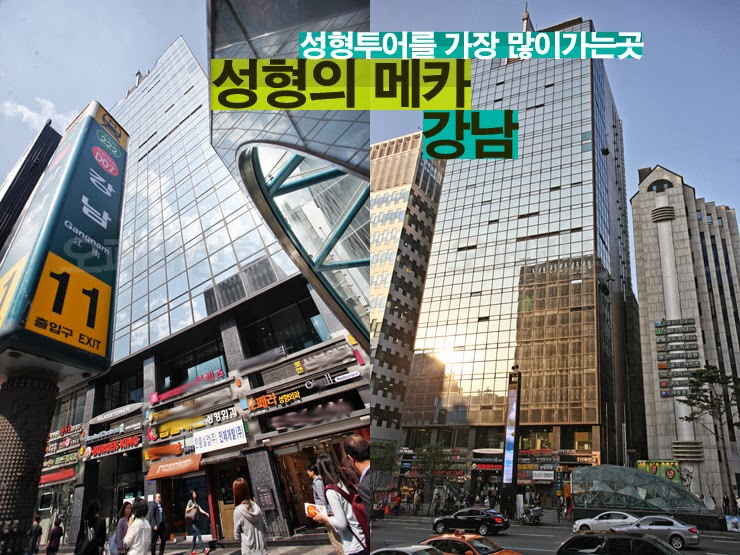
Gangnam is not just for Gangnam Style--it is also the Mecca of plastic surgery in Korea.
It is not a coincidence that glassy skyscrapers, symbols of Korea's prosperity,
house so many plastic surgery clinics.
(source)

Where Tudor and I part company is the reason for such competition. Often, Tudor points to Confucianism as the motivating factor for the excessive competition in today's Korean society. For example, Tudor begins the chapter about competition in Korea with following: "Because Confucianism places a special value on success through education and stable family, Koreans focus on the minimal standard of living at which they will be comparable to others."* Although Tudor then goes into the exposition of how Korea's desperate poverty shaped Korea's national culture (a point with which I am inclined to agree,) starting the chapter with a reference to Confucianism colors the subsequent discussion the chapter.

(*Because I am working off of a translated version of the book, this quote may not be exactly the same as Tudor wrote it. You can blame Mr. Tudor, who sent me a translated version rather than the English original.)

If Tudor's point is that Confucianism contributes to the problems that today's Korean society has, I wonder how Tudor may respond to the following historical tidbit. Pre-modern Korea--through Goryeo and Joseon Dynasties--enjoyed extremely long periods of peace and stability. For nearly a thousand years prior to early 20th century, Korea experienced only one major war that meaningfully threatened its survival. At all other times, Korea had a strong, unitary central government that was able to implement its vision for improving Korean society. Needless to say, such vision was informed by Confucianism.

And by Joseon Dynasty, such effort was wildly successful. One can argue that Korea has reached the pinnacle of an agricultural society by that point. Organized by village units with centuries of farming experience, Koreans have perfected the delicate balance of producing the most amount of harvest without overtaxing the soil. Koreans also diversified their crop, allowing the soil to heal and providing more variety to their table. (Recall that traditional Korean cuisine features more than 1,000 types of edible plants.) The village unit also made effective use of the labor, setting precise schedules of who works when, for what task.**

(**From 김건태, "19세기 집약적 농법의 확산과 작물의 다각화", 역사비평 2012년 겨울호 [Kim Geon-tae, Intensive Agronomy, Diversification of Crops in the 19th Century])

The result was a society that produced everything it needed without too much effort. Thanks to efficient farming, Koreans always had plenty to eat. Indeed, the amount of food that Koreans traditionally consumed nearly defies belief. A diary from the 17th century describes that Koreans ate 7 hob [홉] of rice per meal, or approximately 420 grams. This is around triple of the amount of rice Koreans eat per meal today. Yet Koreans never had to work very hard to eat. Studies show that Koreans did not work all that much except in periods such as planting and harvesting rice, because labor was distributed efficiently. Contrary to the stereotype of hard-working Asians, foreign travelers' account of Korea invariably describe Koreans as "lazy." In truth, Koreans were not lazy. They simply produced everything they needed without spending all that much time.

(More after the jump.)

Got a question or a comment for the Korean? Email away at askakorean@gmail.com.


It is important not to idealize the past, as traditional Korea was hardly the perfect society. It was a monarchy with a class system. It was also a male-dominated society. Further, Korea did not always enjoy abundance of life's necessities--after all, Korea definitely experienced bad harvests and lean times during Joseon Dynasty's six-century-long history.

But it is hard to deny that traditional Korea has certain charms that modern Korea lacks. There was no constant competition or striving that stressed people out--simply people efficiently doing what they had to do to produce more than what they needed, and enjoying their lives in the free time. And these traditional Koreans kept much more closely to Confucianism than today's Koreans do. If Confucianism contributes to the excessive competition that today's Koreans experience, why didn't it cause Koreans of the Joseon Dynasty to compete more, work long hours, etc.? And if Confucianism did not cause that, what did?

Korea's problems do not arise Confucianism; they arise from modernity. Modernity--whose essential ingredients are industrialization and market economy--demands incessant competition. In the traditional economy, the one and only goal is sustenance. Traditional Koreans did not have large, interconnected markets to which they would sell any excess food, nor would there be anyone to buy such excess. Once they produced enough to eat, there is little incentive to produce any further.

A Korean table at a jumak [restaurant and pub], circa 1890.
Note the size of the bowls for rice and soup.
(source)

There is something very attractive about this model. After all, with all the technology we have, why do we work so much? By all indications, there is absolutely no reason for anyone in the advanced economy to work more than 15 hours a week to produce everything we need in life. The experience of traditional Korea shows that even a pre-industrial society can achieve this goal, as long as the society defines down the level of "need." So why do we bother with modernity's stress-inducing demands?

Korea's history provides the answer: if your country does not move toward modernity, modernity will come to your country in the most horrific form possible. To the people who reject modernity, modernity will be imposed. In the late 19th century, modernity first knocked Korea's doors in the form of French and American warships demanding Korea to open its ports. Modernity then busted down the doors with Imperial Japan, which soon enslaved the entire country in the following decades.

The essence of modernity is to turn humans into resources. Market economy and industrialization, operating together, dehumanize, commodify and objectify humans. And no one bears the brunt of such dehumanization quite like the conquered subjects of an empire, who are deemed less of a human in the eyes of the conqueror. Thus, Imperial Japan freely utilized Korea's "human resource"--hideous words, if you think about it--in the most inhumane manner. The empire conscripted millions of Koreans to die in forced labor, hundreds of thousands of Korean women (who were doubly commodified as conquered subjects and receptacles for men's sex) to serve as sex slaves to its soldiers, and thousands to serve as laboratory rats in live human experimentation.

This searing experience left Koreans with an unforgettable lesson: modernize, or literally, die. It is no surprise, therefore, that Koreans singularly focused on modernizing at quickly as possible. This focus was particularly evident in the personal philosophy of Park Chung-hee, under whose dictatorship Korea took the first steps toward joining the first world. (Indeed, "homeland's modernization" [조국의 근대화] is one of Park's favorite phrases in his numerous speeches.) But because Korea was so far behind in the race toward modernity, it was not enough for Korea to simply participate in the race. To catch the countries that were ahead in the race of modernity, Korea had to find a way to break the game.

(source)

In the bestseller Moneyball, Michael Lewis describes how Oakland A's, a team that is perennially strapped for cash and resources, manage to compete and beat the far-better-endowed teams by distilling the game of baseball into its very essence--that is, not getting your batters out. To that end, Oakland A's stripped its team of baseball's traditional and aesthetics preference, and focused only on not getting its batters out. Other  MLB teams would idolize the batters who were physical specimen capable of hitting the baseball. Oakland A's would focus on batters who may not look athletic and appear to be pedestrian in traditional metrics, but were capable of drawing walks--not as aesthetically pleasing as a base hit, but same result at the end.

One can argue that Korea also made up for its disadvantage by distilling modernity into its very essence: commodification. In its furious race toward modernity, Korea arguably managed to commodify its people better than any other country in the world. It helped that Koreans had already experienced modernity's terrible commodification at the hands of Imperial Japan, and were broken by Korean War into poverty and desperation. To be sure, Korea's commodification did not necessarily mean endless hours of sweatshop labor, although sweatshops were a crucial component in the early stages of Korea's economic development. Korea invested massively in public education and raised a huge corps of highly able people. Through the combination of nationalistic exhortation and authoritarian rule, Korea squeezed maximum amount of quality labor out of them. The result is as we see today: Korea at the forefront of modernity, the fastest country to have done so in human history.

But such ruthless commodification of humans left numerous scars in Korean society, because unlike that of baseball, the essence of modernity is toxic. It is only a slight exaggeration to say that every social problem in Korea is ultimately reducible to commodification. Korean people kill themselves at a record rate because, in a society that replaced the traditional family-based relationship with modern employer-employee relationship, the unemployable no longer has any further reason to exist. Koreans double down on education precisely to avoid this fate and make themselves employable. Korean women undergo plastic surgery at a record rate because they are commodified based on their looks in both the job market and the marriage market. Koreans are both too busy to invest in themselves, and too concerned that their children will have to run in the same, tiresome hamster wheel; so they forgo having children, or have no more than one. Above all, in this inhuman modern society, Koreans are stressed out and unhappy.

Focusing on the true cause of Korea's social ills illuminates the true lessons to be learned from Korea's experience. The first lesson is that focusing on Korea's unique history and cultural tradition does not help finding the solution for Korea's issues. If Korea's tradition is the cause for Korea's social ills, one would observe the same ills afflicting Korea throughout its history. This is simply not the case. In fact, much of Korea's tradition would counsel against the afflictions of modernity. Confucian education, for example, is about building a certain moral character, rather than learning specific skills to become an employable cog in the modern economy. The educational fervor in Korea has gone past the level of diligence, and is now in the territory of constant exhaustion. Having Korea's education focus again on character-building, rather than picking up an ever-increasing number of skills, would moderate this desperation that ruining Korea's children today.

The second lesson is the extension of the first. Korea's problem is not Korean culture; Korea's problem is modernity itself. Thus, Korea's problem is not limited to Korea, but is universal, and afflicts every contemporary industrialized, capitalistic society. Broad survey of modernized countries reveals that echoes of Korea's problems exist all over the world, albeit in different degrees. Korea is frequently cited for having high suicide rates, but sociological studies make it abundantly clear that every single industrialized country in the history of the world experienced a huge spike in suicide rate in the process of industrializing, and later the country industrialized, the higher the spike. Korea's high rate of plastic surgery receives international focus, but Brazil, another up-and-coming industrialized nation, is also making headlines for huge numbers of plastic surgery. Although Korea's fervor for education is often considered as excessive, in the United States, the doubling down on education set off a nuclear arms race of diploma inflation of the kind seen in Korea.

(Aside:  The trend of globalization, which is just another name for worldwide modernization, takes this worldwide commodification of humans to a new low. FoxConn laborers in China kill themselves in droves, while hundreds of workers in Pakistian die in a fire that supposedly passed the fire inspection, all in the process of manufacturing goods for wealthy, first world consumers. But even the first world consumers are no longer safe: as the international competition improves, the ruthless efficiency-seeking machine siphons the wealth that previously sustained the first world's middle class to the new capitalists of the rest of the world. In the modernized world, mediocrity has nowhere to hide.)

That Korea's problems are universal to modern nations leads to a disconcerting realization: solving these problems would require a complete redirection of human civilization from the path that it has taken for the last 250 years. It is not clear if this is even possible; it is equally unclear if this is desirable. For all of its problems, modernity also has enormous benefits in the form of unprecedented wealth (albeit distributed unevenly), advanced medical science and greater knowledge about the world around us. Even in the limited context of Korea, this inquiry retains the same character: for all of their complaints about today's Korea, would Koreans really want to go back to the way things were, three centuries ago? Are Korea's problems--stress, low birthrate, suicide--just something that Korea must learn to deal with, in exchange for the dividends of modernity? Can any one society refuse the tide of modernity today without getting swallowed up by other societies, which would continue to march toward superior economy and military?

These are important questions. They are also exceedingly difficult, and their scope is far greater than a single national culture or tradition. As such, in discussing Korea's problems, it is a mistake to focus solely on Korea's tradition or Korea's culture. Korea's problem is modernity, and Korea's problem is the world's problem. Fixing it requires not some tinkering of Korean culture, but a redirection of the human civilization.

Got a question or a comment for the Korean? Email away at askakorean@gmail.com.